

© Adobe Stock/Pinkeyes A specialist works in a data center. From AI to “killer robots”: UN Secretary General calls for urgent development of global rules for regulating artificial intelligence Economic Development
UN Secretary-General Antonio Guterres on Monday called for the development of a comprehensive global regulatory framework for artificial intelligence (AI). He warned that increasingly powerful technologies originally created for civilian purposes are beginning to be used on the battlefield, where “killer robots” have already become a reality.
Speaking at the opening of the first UN Global Dialogue on Artificial Intelligence Governance in Geneva, the Secretary-General also stressed the need to ensure access to technology for the billions of people who are not yet enjoying the benefits of digital revolution.
Any future international agreement, he said, must be “trustworthy of the world” and put the safety of people, especially children, at the forefront, protecting them from manipulation and abuse using digital technologies.
The Chairman of the 80th session of the UN General Assembly, Annalena Burbock, joined the call. She called for collective action against the “dark side” of artificial intelligence, recalling that 99 percent of deepfakes are reportedly sexual in nature, and 96 percent of deepfakes target women and girls.
Close the digital divide
Guterres named several more key areas for future regulation. These include guaranteed access for developing countries to artificial intelligence technologies, as well as the conversion of all data centers supporting AI to renewable energy sources by 2030.
Artificial intelligence “is at the very center of our shared future,” according to the UN chief, but people must make decisions and bear responsibility for them.
International dialogue
In the three years since the rapid expansion of generative AI, this technology has had a revolutionary impact on the economy and society – both positive and negative.
The UN has played a leading role in recent years in international efforts to develop mechanisms for regulating AI. An important step in this process is the first Global Dialogue on Artificial Intelligence Governance, which opened on Monday in Geneva.

UN Musician Gadi Sassoon, who draws inspiration from artificial intelligence, speaks at the Global Dialogue on AI Governance in Geneva.
It is attended by representatives of technology companies, the scientific community and civil society, as well as experts and cultural figures. They discuss how to ensure technology development takes into account the interests of humanity. The next Global Dialogue is scheduled for May 2027 in New York.
“Artificial intelligence is too important for its development to be determined by only a small group of players. We need a global, inclusive and evidence-based dialogue,” said the UN Secretary-General’s Special Envoy for Digital and Emerging Technologies, Amandeep Singh Gill. Bengio noted that there are no signs of the technology slowing down yet.
“Advanced artificial intelligence models are already capable of misleading people and understanding when they are tested,” he said.
According to him, the level of cognitive capabilities of AI will continue grow.
“It sounds like science fiction, but this prospect is quite real. It has the potential to change the world in ways we do not yet understand, and to change the global balance of power in ways that require our utmost attention,” the scientist warned.
“The Great Equalizer”
If used responsibly and widely available, AI has the potential to “shorten the decades needed,” the Secretary-General said. for development, up to several years” and become “the great equalizer of the 21st century.” However, to achieve this, technologies must undergo rigorous safety testing, and responsibilities for their use must be clearly defined.
“When countries agree on common approaches to testing systems, assessing risks and sharing responsibilities, security becomes an integral part of the technology itself. When this does not happen, a mosaic of incompatible rules emerges that increases costs, divides the world and protects no one,” Guterres emphasized. artificial intelligence.
“No child should become a guinea pig for unregulated artificial intelligence,” he said. – We do not allow the use of drugs until they are proven safe. We check every toy. However, artificial intelligence has already entered children’s lives – school, friendship and the most personal matters – even before anyone wondered what impact it would have on them.”
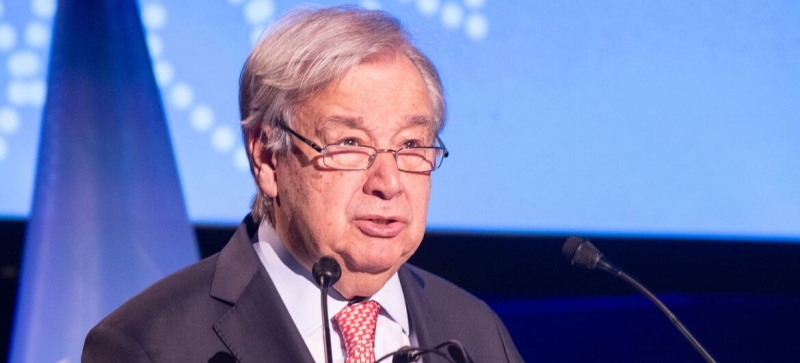
Photo UN/I. Butt Secretary-General Antonio Guterres speaks at the opening of the Global Dialogue on AI Governance.
According to a UN initiative, AI developers will have to prove that their systems are safe for children. No company should release a product accessible to children without special testing and independent monitoring. It is also proposed to establish a zero tolerance principle for the creation of images of child sexual abuse by artificial intelligence. All such materials should be automatically detected, reported to the competent authorities and removed.
In addition, if the system detects signs of psychological distress in a child, it should stop the interaction and refer him to real specialists. transparency
The UN head named respect for human rights as another key principle of future regulation.
Read also:
EXPLAIN | Advancing AI: Why the World Needs to Act Now
“Artificial intelligence should never strip people of their dignity or reinforce discrimination. In matters of justice, healthcare or law enforcement, machines can help, but decisions and responsibility should always remain with humans,” he said.
Public investment is not yet comparable to private investment
Guterres also called for increased public investment in the development of AI. According to him, the volume of private investment in artificial intelligence infrastructure today amounts to about $500 trillion, while government support for developing countries in this area remains “a drop in the balance.” sea.”
To bridge this gap, The Secretary-General announced that more than 20 countries have already supported the UN initiative to create a Global Network of Knowledge Sharing and Cooperation to develop capacity in the field of AI.
“We cannot Let the digital divide become an AI divide, and then a development, security and sovereignty gap,” he stressed.
AI Ecological Footprint
The Secretary-General again called on major companies to publish information about the environmental footprint of their AI systems – electricity, water and land consumption – and to ensure that all data centers are powered by renewable energy by 2030. “Artificial intelligence may seem intangible, but its environmental footprint is very real,” said Guterres.
According to him, by 2030, data centers could consume more electricity than all but the five largest countries in the world, and the volume of water they use will be comparable to the annual needs of 1.3 billion people in sub-Saharan Africa.
In this regard, the UN chief again called for support for the Organization’s environmental transparency initiative in the field of artificial intelligence.
How international efforts to regulate AI have evolved
2017: The UN Secretary-General has called for the creation of international mechanisms to regulate artificial intelligence for the first time. At the time, he noted the technology’s “astounding” potential, while warning of its possible impact on the labor market, international security and the “social fabric.”
60~p>60~strong>62~2023: A high-level advisory body on AI calls for the creation of a global governance framework for the technology. technology.
2024: The Pact for the Future and the Global Digital Compact mandated the development of an international governance model for AI.
June 2026 year: The UN’s Independent International Scientific Panel on Artificial Intelligence has warned that AI has the potential to “cause catastrophic consequences, either alone or through malicious use,” as technology advances outpace both scientific understanding and the ability of states to adapt to new challenges.
6-7 July 2026: Geneva hosts the first UN Global Dialogue on Artificial Intelligence Governance and the AI for Good Summit.
According to the Secretary-General, these events should determine the future direction of international effort.