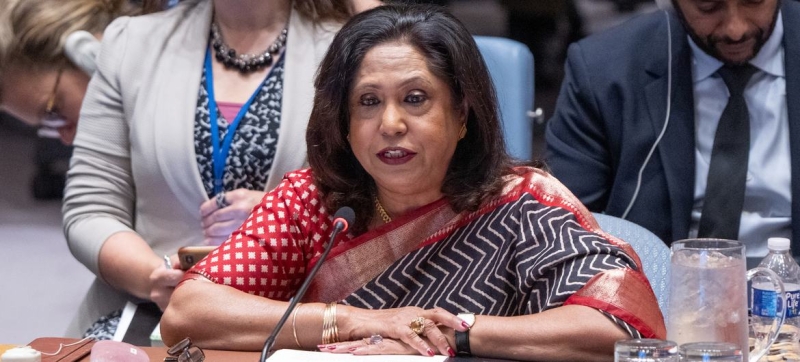

UN Photo/E. Debebe Pramila Patten, Special Representative of the Secretary-General on Sexual Violence in Conflict, addresses the Security Council. Photo from the archive Conflicts are becoming increasingly violent: the UN reported a sharp increase in sexual violence in war Peace and Security
The number of cases of sexual violence associated with armed conflict verified by the United Nations has more than doubled in the past year. This was stated by the UN Secretary-General’s Special Representative on Sexual Violence in Conflict, Pramila Patten, speaking on Wednesday at the Security Council’s open debate on the protection of victims and respect for international law.
This year’s annual Security Council debate is chaired by the Prime Minister of the Democratic Republic of the Congo, Judith Suminwa Tuluka. The session was titled “Implementing International Law Obligations for Survivors of Conflict-Related Sexual Violence.” Patten said the Secretary-General’s report to the Council reflected alarming changes in the nature of modern warfare.“[Obligations under] international law have never been more relevant and at the same time so seriously tested. The report before us today reflects the changing face of war,” she said.
Nearly ten thousand confirmed cases
According to the report, the UN was able to verify 9,788 cases of conflict-related sexual violence in 2025. This is more than double the previous year. However, the organization emphasizes that the real number of victims is much higher, since most such crimes remain unreported.
As Patten noted, humanitarian organizations estimate that for every case that reaches medical facilities, there are ten to twenty cases that go unreported.
The report covers 21 situations related to armed conflict. The largest number of confirmed cases have been reported in the Democratic Republic of the Congo, Haiti, Sudan and the Central African Republic. About 90 percent of victims are women and girls, but men and boys are also victims of violence, especially those in detention. The ages of the victims ranged from one year to more than 70 years. Nearly three thousand confirmed cases were among children, up 37 percent from the previous year.
Not a “side effect” of war
Pramila Patten emphasized that sexual violence is not an accidental consequence of combat. “These crimes can no longer be considered “collateral damage” or random, “opportunistic” excesses of individuals appropriating the “spoils of war.” It is a deliberate attack on human dignity, community cohesion and collective security,” she said.
Sexual violence is used as a tool of war, terror, torture and political repression, she said. It promotes forced population displacement, destroys families and entire communities, and is often accompanied by the killing of victims to cover up crimes. More than 65 percent of them have been on this list for five years or more, without taking the necessary measures to stop the violations.
This year, for the first time, the list includes the armed forces of Israel and the Russian Federation, as well as several non-state armed groups in the Democratic Republic of the Congo and Haiti. According to Patten, demands were sent to Israel and Russia as early as August last year to stop abuses, allow unimpeded access for UN observers and take measures to ensure accountability for those responsible, but there has been no significant progress. after the [Russian] invasion of Ukraine in 2022,” Patten emphasized.
Call to Action
At the end of her speech, the Special Representative of the Secretary General emphasized that international law itself, without the political will of states, is not capable of protecting people.
“We are not compiling these reports to simply count the number of victims; we make them up because the victims are counting on us. They look to this Council to turn documenting crimes into accountability, rights into protection, and atrocities into helping victims,” Patten said. She called on States to strengthen civilian protection mechanisms, provide assistance to victims and ensure that perpetrators are held accountable, stressing that sexual violence in conflict must not remain unpunished.
Russia denies the accusations against itself
In his speech, Deputy Permanent Representative of the Russian Federation to the UN Dmitry Chumakov named sexual violence in armed conflicts “a monstrous manifestation of cruelty, contrary to the foundations of morality and basic humanitarian principles.” He rejected all accusations against Russia, saying that the report “lacks objectivity.” In particular, the diplomat emphasized that the office of the Special Representative is not directly related to the process of verifying the data contained in the document and relies on the UN Human Rights Office in this matter. “Meanwhile, sexual violence is systematically used by Ukrainian military personnel and security officials…” added Chumakov.