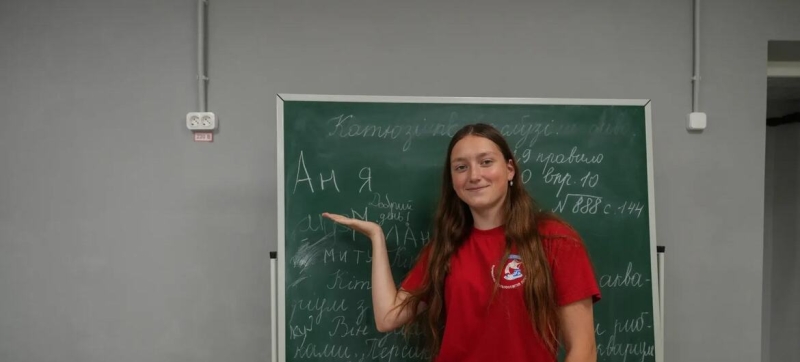

© UNICEF Anya, a 10th grade student at the Varvinsky Lyceum. Ukrainian schools return to in-person learning despite power outages and air raid alerts Peace and safety
Anya walks hesitantly between the desks, trying to guess which one she will be seated at. Before the first day of school, a tenth-grader is more excited than on her very first day of school. Thanks to a new shelter with Internet access, equipped with the support of UNICEF, children in a Ukrainian village will be able to go to school after a long break.
“The last time I sat at a school desk was in the fourth grade. After so many years, for the first time I have the opportunity to return to class with other children,” says a student from Varvinsky Lyceum No. 1.
The war took away her home and school. The shelling forced her family to leave the east of the country and move to the Chernihiv region. Now, after several years of distance learning, Anya is relearning how to write with chalk on a blackboard, joke with friends during recess, and pack her school backpack.
“I’m from Nikolaevka, it’s next to Slavyansk. My city is destroyed, my home and school are in ruins. We moved to the village of Varva. From September, the Varvinsky Lyceum resumes face-to-face classes. There is a safe shelter, independent heating, and I will be able to go to school without interruption. I want to study again, catch up and make friends,” she says.
A hard winter that will be remembered for a long time
Varvinsky Lyceum No. 1 has a long history: this year its 90th graduation will take place. According to director Tatyana Prishchenko, last winter turned out to be one of the most difficult in recent years.
“It was a difficult year. And not only because of air raids and danger, but also because of the unusually cold winter. There were days when there was no electricity for 18 hours,” she said.
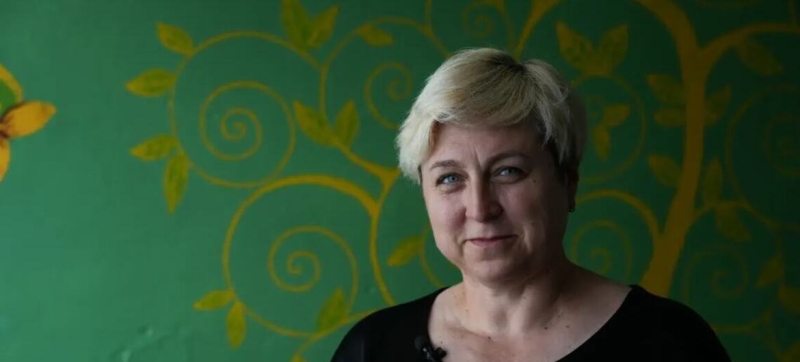
© UNICEF Director of the Varvinsky Lyceum No. 1 Tatyana Prishchenko.
All last year, Tatyana tried to keep the educational process afloat, despite blackouts and shelling. Due to the cold weather, the lyceum switched to distance learning, but this decision brought its own difficulties – first of all, frequent and prolonged air raids and power outages.
“Without electricity there was no heating, no way to feed the children, no communication. It was a difficult winter – it also affected my studies and led to real losses in knowledge. The level of academic achievement has decreased, as throughout the country,” noted Prishchenko.
New shelter for schoolchildren
At the end of last year, the state allocated funds for the construction of a large shelter with autonomous heating at the Varvinsky Lyceum No. 1. It is equipped with supplies of clean drinking water, toilets, Internet access and an alarm system.
Read also:
UN records record increase in attacks on educational institutions
Thanks to funding from the German government through the UN Children’s Fund (UNICEF), the school installed hybrid inverters and batteries to ensure uninterrupted power supply.
“We are no longer dependent on blackouts and cold weather. Inverters give us backup power, so even in a shelter we will have light, heat and internet. We can say that the shelter has become our second school – an underground one,” the director emphasized. The shelter can accommodate almost all 500 students of the lyceum.
UNICEF support
In 2026, 1,380 educational institutions in eight regions of Ukraine received a one-time payment from UNICEF with the support of the German government. These funds will help schools and kindergartens reduce interruptions in learning due to power and heating outages. Thanks to this, 400 thousand children will be able to continue studying in person or in a mixed format, even in the cold winter. Germany allocated similar funding to 700 schools in 2024-2025.
Catching up
A difficult winter was one of the reasons why Anya decided to switch from distance learning at her school in Nikolaevka to full-time classes at the Varvinsky Lyceum. Last winter she had almost no lessons.
“This winter has been hard for us. We often had no light or heating, so we had to dress warmly and cover ourselves with blankets. We warmed ourselves with gas or hot water bottles. I almost didn’t study at school, because almost no one had electricity – neither the teachers nor the students,” she said.
Anya tried to sort out the educational material on her own. Now she is worried about the upcoming exams, realizing how much she has to catch up on. She admits that she is even a little scared to think about going to university.
“I really hope that I can catch up, especially in mathematics and history,” says Anya.
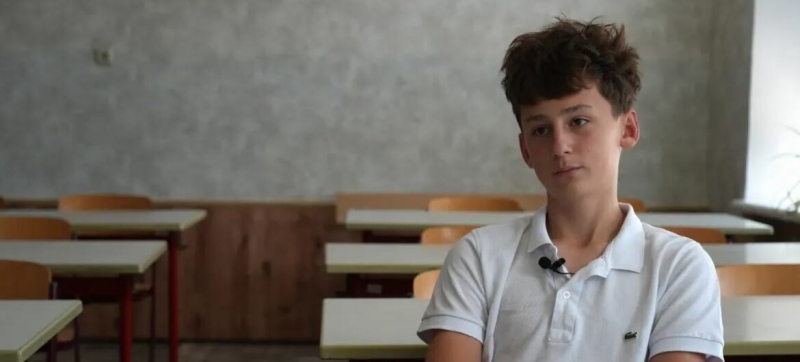
© UNICEF Anya’s classmate, 14-year-old Andrey.
According to her, for four years she had almost no physical education lessons – this subject is especially difficult to master remotely. To keep in shape, she signed up for a local travel club, which trains in the gym of the Varvinsky Lyceum No. 1. This is how she met its students and saw the school for the first time, which she later decided to go to.
“I really miss home – my Nikolaevka, my room, my friends. But my friends are no longer there, everyone has left. And the house is no longer there either – it is destroyed. The entire city was badly damaged. Probably what I miss most is new experiences. That’s why I want to make friends here,” Anya shared.
Nothing can replace full-time education
Anya’s classmate, 14-year-old Andrei, was looking forward to September 1st. He was born and lives in Varva – far from the front line, more than 100 kilometers from the border with Russia. But the war is felt even here.
“The war affected my nervous system. When “Shahed” hit the building next to my house, my blood pressure jumped, my mood swings began, and I became withdrawn. As the air raids became less frequent, I gradually came to my senses,” he says. Studying and sports help him cope with anxiety.
During the years of full-scale war, Andrei studied both full-time, remotely, and in a mixed format. But the teenager is sure: nothing can replace face-to-face classes. After a long period of distance learning last year, he hopes 10th grade will be different – thanks to the new shelter and backup power.
“There were lessons over the phone. We also worked out in the gym because there was no shelter. In winter, we switched to distance learning, and I studied at home by the light of a flashlight. Sometimes it was not even possible to connect to the lesson due to a bad signal. But now we have a real shelter, and air raids no longer stop us,” notes Andrey.
Andrey, as a local resident, gives Anya a tour of the shelter, which she has not yet seen. “Here, downstairs, now we won’t even notice if the lights are turned off upstairs,” he says, showing her their future classroom.
Anya takes the chalk and writes her name on the board. And then smiles broadly.
The text has been prepared based on the material UNICEF.