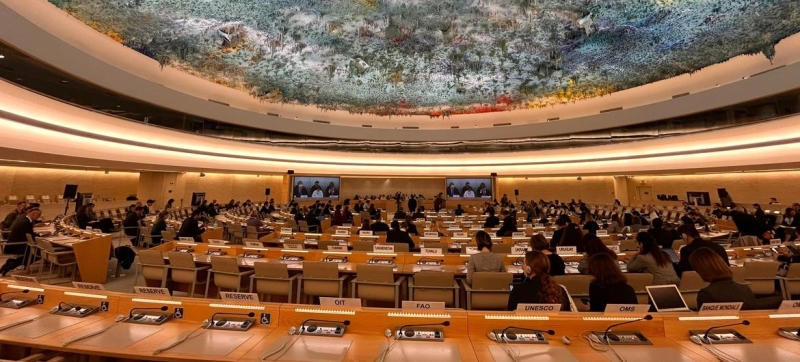

© OHCHR Meeting room of the UN Human Rights Council. The session of the UN Human Rights Council starts on Monday Human rights
On Monday, September 7, the 63rd session of the UN Human Rights Council will open at the Palais des Nations in Geneva. Over the course of five weeks, the Council’s 47 member states will review the human rights situation around the world, hold 37 interactive dialogues with independent experts, and adopt dozens of resolutions.
On the first day of the session, the UN High Commissioner for Human Rights Volker Türk will present his updated overview of the situation in the world.
What will be discussed at the autumn session sessions
The session will focus on a number of crisis situations, including Afghanistan, Syria, Myanmar and Sudan. In particular, the Council will hear the report of the Independent International Fact-Finding Mission on Sudan, and the High Commissioner will separately brief delegates on the situation in El Obeid, the capital of Northern State Kordofan.
On Friday, September 18, the HRC will discuss the report of the Group of Independent Experts on the human rights situation in Belarus, as well as the situation in a number of other countries.
On Monday, September 21, three interactive dialogues will take place: on the reports of the Special Rapporteur on the situation of human rights in the Russian Federation, the Independent International Fact-Finding Mission on the Islamic Republic of Iran, and the Independent International Commission of Inquiry on Violations in Ukraine. the Occupied Palestinian Territory, including East Jerusalem, and the occupied Syrian Golan. On the same day, there will be a general discussion on the human rights situation in Palestine and other occupied Arab territories. In addition, in the fourth week of the session, participants will discuss the situation in Haiti, the Central African Republic, the Democratic Republic of Congo, Somalia, Cambodia and Yemen.
Unilateral sanctions and the rights of the elderly
Independent experts appointed by the HRC will raise a wide range of issues: the rights of older people, access to safe drinking water and sanitation, modern forms of slavery, hazardous waste, arbitrary detention and enforced disappearances, the rights of peasants and rural residents, the use of mercenaries and the activities of private military companies. speaker on the negative impact of unilateral coercive measures on the enjoyment of human rights – he will talk about how sanctions imposed by individual states, bypassing the UN, affect people’s lives, their access to food, medicine and medical care.
Three Anniversaries and Global themes
The Council will mark the 60th anniversary of the International Covenants on Human Rights, the two 1966 treaties that together with the Universal Declaration constitute the International Bill of Human Rights, as well as the 40th anniversary of the Declaration on the Right to Development and the 15th anniversary of the UN Declaration on Human Rights Education and Training. Each of these dates will feature a high-level discussion.
In addition, the HRC will hold thematic discussions on how to protect economic, social and cultural rights in the face of growing inequalities, on the rights of indigenous peoples, and on mainstreaming a gender perspective into the work of the Council and its mechanisms.
The session will also include a presentation a report by the UN Secretary-General on how to mobilize sufficient resources to finance climate action, and an annual report on the persecution of people who cooperate with the UN.
Decisions and resolutions
At this session results of the periodic review of the human rights situation in 15 states – Namibia, Niger, Mozambique, Estonia, Paraguay, Belgium, Denmark, Palau, Somalia, Seychelles, Solomon Islands, Latvia, Sierra Leone, Singapore and Nicaragua.
Last three days of the session, from 5 until October 7, will be dedicated to voting on draft resolutions and decisions. The Council will appoint a new Special Rapporteur on the right to safe drinking water and sanitation, as well as a Special Rapporteur on Eritrea, subject to the extension of the mandate. In addition, five members of various working groups will be appointed and seven members of the Council Advisory Committee will be elected.