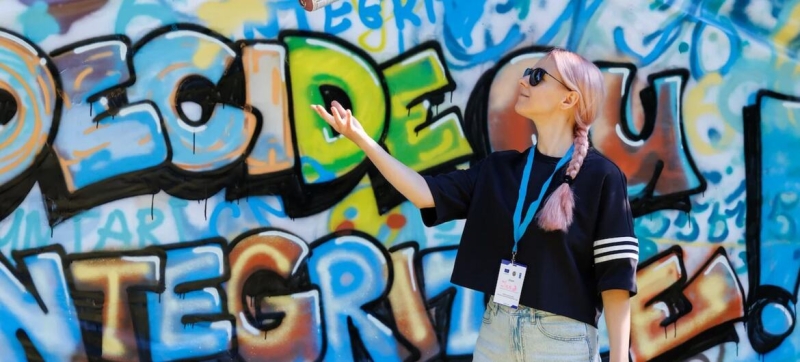

© UNDP Moldova Inna Berega’s works adorn the walls of houses throughout Moldova and far beyond its borders. Inna Beregoy: a drawing that sounds like a voice Culture and education
As a child, drawing was one of the few living spaces where Inna Beregoy felt truly free. Not because she dreamed of becoming an artist, but because on paper it was often easier for her to express what was impossible to say out loud.
Today her works decorate houses throughout Moldova and far beyond its borders – in different European countries. For the artist herself, known under the pseudonym iZZY iZVNE, graffiti remains the same as it was many years ago – a way of communicating with the world. “I am a very reserved person,” says Inna. “There were times when I felt like I was swimming aimlessly against the current. But, looking back, I understand: everything that I had to go through helps me share my experience with children and youth today.”
Forms, meanings and new readings
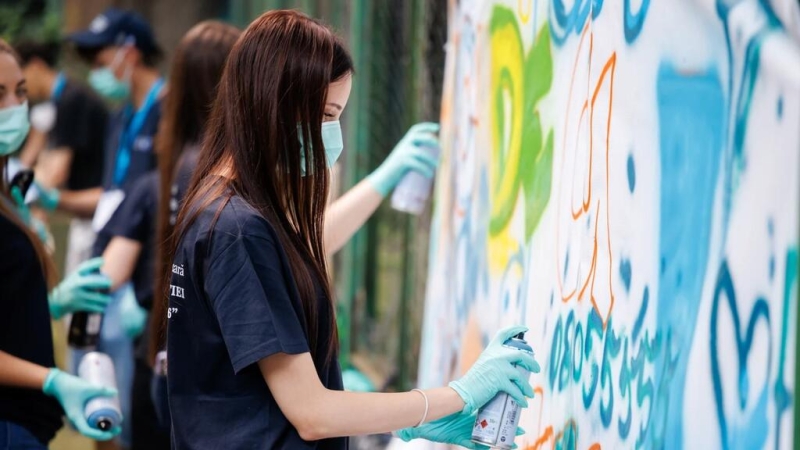
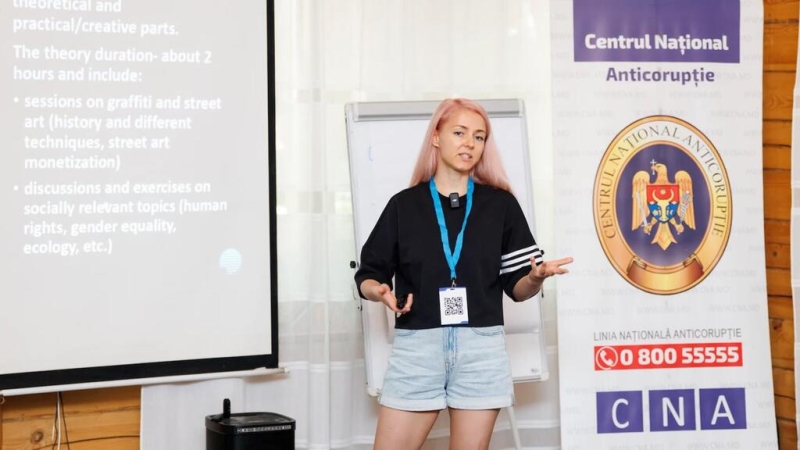
Today, Inna works in graffiti and street art, is the founder of the Urban Spirit Family collective, and coordinates projects involving children and young people from all over Moldova. In recent years, Inna’s team has transformed dozens of city walls into large-scale murals dedicated to human rights, gender equality, environmental protection and integrity issues. However, when the artist is asked about the main thing in such projects, she does not talk about the size or the complexity of the drawing. “We don’t just come and paint the wall,” she says. “First of all, we talk to the children, listen to them, and then together we come up with a concept for the future mural. As a result, they see that they had a hand in the work. They feel that their voice is important and that they are able to change the spaces around them.” Inna does not strive to completely control the creative process. Her own works are born from a clearly formulated artistic concept, but her master classes are structured differently. Each child brings their own ideas, so the final result can never be predicted in advance: “We don’t tell them what to do or limit their imagination. We trust their own understanding of creativity.” © UNDP Moldova Over ten years of work, Inna and the Urban Spirit Family team have visited almost all regions of Moldova. Inna is known for her recognizable artistic style based on three-dimensional shapes and calligraphy. For almost ten years she has been forming her own visual language. Even her creative pseudonym reflects her view of the world. The name iZZY appeared long before the acquaintance with graffiti, and iZVNE symbolizes the desire to open a window into the inner world through art. The path to the current recognition was not easy for Inna. When she first entered the world of graffiti, she quickly realized that she was entering a territory where women were few and where they were viewed with skepticism. At first, she didn’t even realize how different the treatment of men and women in this field was in this field. “I sincerely believed that equal opportunities were open to women. Only after becoming part of this community did I see how different reality is from my ideas,” recalls Inna. Over the course of many years, Inna had to master not only the technique and discipline of street art, but also learn to overcome prejudices. For a person who considers himself an introvert, this pressure was especially difficult: “There were very difficult moments. Sometimes it seemed that some people were trying to stop me simply because I was there. At some point, I realized that the problem was not in me, but in the system around me.” Looking back, Inna says that it was this experience that changed the trajectory of her work. If earlier graffiti was primarily a way of personal expression, today it is a tool that helps you believe in the value of your own ideas. The children and teenagers with whom Inna works are not taught to draw perfectly. They are encouraged to talk about what they think and feel, and drawing becomes the language of this conversation. For ten years of work, Inna and the Urban Spirit Family team have visited almost all regions of Moldova. Although projects are also being implemented in cities, the strongest impressions, she says, are left in small towns, where children are less likely to have the opportunity to engage in creativity and where their opinion is not often asked. “We like to work where there are almost no such initiatives,” says the artist. – For local children and youth, our projects become a real breath of fresh air. Usually we choose the walls of schools, stadiums or other places that are significant to young people.” © UNDP Moldova The mural continues to live after the completion of the master class: it becomes an invitation to dialogue. According to the artist, it is always noticeable how important it is for children to be heard: “Their eyes light up when they realize that someone is really interested in their opinion.” The mural is only a visible part of a much larger process. Before the first outline appears on the wall, the children discuss ideas, share thoughts and together form a message that they want to leave to others. “It is very important for us that this work belongs to them,” Inna emphasizes. – We do not strive for an ideal result. It’s important to us that they recognize themselves in what happened and are proud of creating an image that will remain here for many years.” The mural continues to live after the completion of the master class: it becomes an invitation to dialogue. Children pass by it every day. Parents pay attention to him. Teachers discuss it in class. A piece of work created in one day can become a starting point for conversations that would never have happened otherwise. “This is how a dialogue is born with society, with parents, teachers and everyone who sees the mural,” explains Inna. “Children are beginning to understand that their voice has weight and that they are capable of changing the environment.” Sometimes such conversations can be difficult. Inna recalls a master class in one of the villages of southern Moldova, dedicated to gender equality and human rights. Some participants expressed views shaped by a traditional upbringing, making the discussion tense. At some point, some of the children left, but others stayed. They continued to discuss, ask questions, and eventually created a drawing together. “This experience once again showed me how important such meetings are,” says the artist. “Even if you can’t convince everyone in one day, you can create a space where people can hear another point of view.” Stories like this only strengthen her belief in the power of art to connect people: “Art is a language that young people understand perfectly. It does not force you to memorize the correct answers and does not dictate what to think. It invites participation, questioning and expression.” Graffiti classes often attract teenagers who initially have little interest in human rights or integrity topics. Some come for the art itself, some want to try working with aerosol paint, and others are simply looking for a new experience. But gradually many people understand that this is not only about drawing. “Some come solely because of the graffiti,” says Inna, “and then stay for the sake of communication. When we return to the same places a year or two later, we find that young people are much more free to discuss issues of equality, human rights and other social issues.” © UNDP Moldova Inna and the Urban Spirit Family team collaborate with the United Nations Development Program (UNDP). The impact of such projects is measured not only by the number of works created and the number of participants. It is also manifested in the way the communities themselves begin to perceive these images. In many cities where the Urban Spirit Family created murals, they eventually became local landmarks and a source of common pride. Today Inna looks with gratitude at the path traveled. Not because her work has appeared in different countries or that she has managed to create a recognizable style, but because she sees how her work changes people: “The energy we get from children is priceless. Every time it seems to us that we receive much more than we give. That’s why I know I’m doing what I’m really supposed to do.” Inna and the Urban Spirit Family team are collaborating with the United Nations Development Program (UNDP) to promote the principles of integrity, civic engagement, mutual respect and environmental responsibility. The slogan “Choose Integrity” has become the central message of a number of murals created young people who have been involved by the European Union and UNDP in initiatives to promote honest and ethical behavior. Murals “Defend the Dniester!” in the city of Rezina and “Water is life. Let’s protect the Dniester! in the village of Talmaz, Stefan Voda region, messages are conveyed through art to children and youth who participated in projects supported by Sweden and UNDP. These works remind us of the importance of preserving the Dniester River and the personal responsibility of everyone for water resources.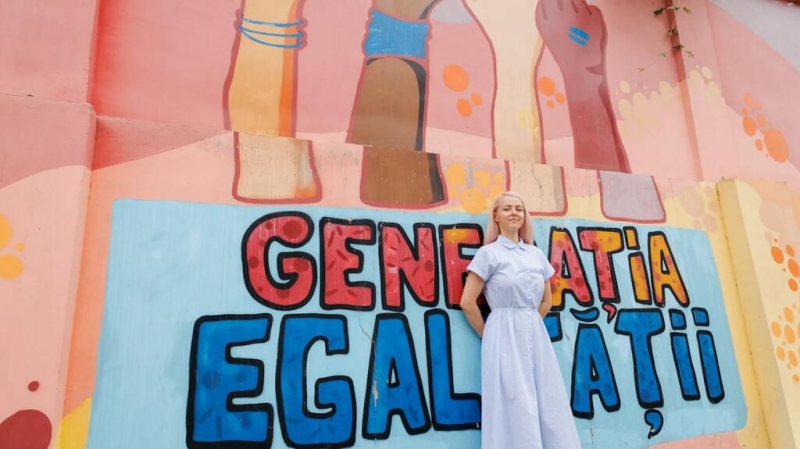
Window to the world of Izzy
Art beyond stereotypes
From the purely personal – to a language understandable to everyone
Mural as a conversation starter
Beacons of public spaces
Partnership with UNDP