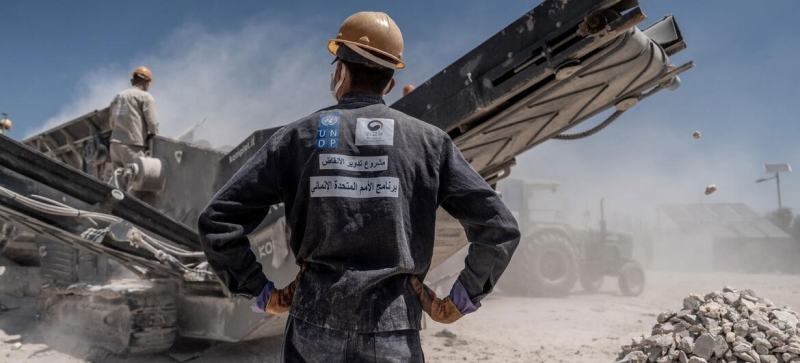

© UNDP/J. Clark United Nations Development Program (UNDP) staff are providing support to clear debris in Syria. Syria at a crossroads: UN calls for support for political transition and reconstruction of the country Peace and Security
Syria has seen some progress in stabilizing the political situation and rebuilding the country, but internal contradictions and regional tensions may jeopardize the achieved results. UN representatives stated this on Thursday, speaking at a meeting of the Security Council.
Deputy Special Envoy of the Secretary-General for Syria Claudio Cordone, speaking from Damascus, recalled that UN Secretary-General Antonio Guterres visited Syria last month. This was the first visit of the UN head to the country in 17 years.
At meetings with senior government officials, the Secretary-General welcomed progress in the field of political transition, including steps to strengthen state institutions, reconciliation, ensuring accountability and transitional justice.
At the same time, Guterres emphasized that the success of the transition will ultimately Ultimately, it will depend on whether all Syrians feel that they are represented in state institutions and can truly participate in determining the future of their country.
Cordone welcomed the US decision to remove Syria from the list of state sponsors of terrorism. According to him, this should create more favorable conditions for economic recovery, investment and international cooperation. An International Monetary Fund mission that visited Damascus last month forecast double-digit economic growth for Syria in 2026. However, widespread poverty and a new round of inflation mean that the situation for most Syrians remains dire.
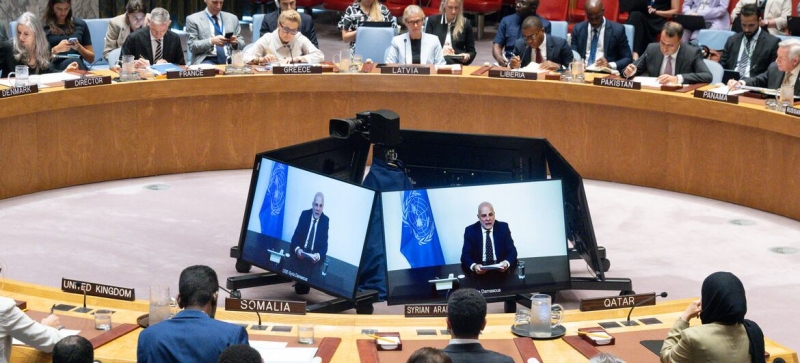
UN Photo/E. Debebe The UN Secretary-General’s Deputy Special Envoy for Syria, Claudio Cordone (on screen), addresses the Security Council.
One of the most important tasks remains the creation of a permanent constitution. The process of its preparation has not yet been determined. The UN calls for it to be inclusive, transparent and open to the participation of different groups in society, as well as to begin preparations for elections at the end of the transition period.
Justice remains an important part of the transition process. This month, a criminal court in Damascus sentenced several former senior officials to death, including former President Bashar al-Assad, who was tried in absentia. In accordance with UN policy, Cordone called on the Syrian authorities to impose a moratorium on all executions.
Cordone also expressed concern about ongoing Israeli military activity in southern Syria, including ground raids, house searches and destruction of private and agricultural property. He said that Israel’s presence east of the ceasefire line violates the sovereignty and territorial integrity of Syria, and condemned the Israeli airstrike on the Abu al-Duhur airbase on August 18.
However, the UN representative welcomed direct contacts between Israel and Syria and negotiations in Jordan. “Diplomacy must prevail and negotiations must move forward within the framework of international law,” Cordone said.
Serious security problems remain at home. Although overall levels of violence decreased in August compared to July, reports of killings, disappearances and deaths in custody continued. ISIS remains a serious threat.
At the same time, the UN welcomed progress in the integration of the northeast of the country after the August 25 meeting between President al-Sharaa and Mazloum Abdi. Cordone noted Abdi’s announcement of the end of the Syrian Democratic Forces’ mission and its disbandment and reiterated UN support for the continued integration process. Acting Assistant Secretary-General for Humanitarian Affairs and Deputy Emergency Relief Coordinator Indrika Ratwatte. He spoke on behalf of the UN Under-Secretary-General for Humanitarian Affairs and Emergency Relief Coordinator Tom Fletcher.
Ratwatte, who last week visited Deir ez-Zor, Raqqa, Aleppo and Idlib, noted signs of recovery after years of conflict, displacement and economic decline.
“Syria is at a turning point, and Syrians are hopeful for a stable and prosperous future,” he said.
Increasingly people are returning home, energy and transport networks are gradually being restored, and commercial activity is increasing. This year’s wheat harvest may allow Syria to achieve seasonal self-sufficiency, according to reports.
However, humanitarian needs remain enormous. Millions of people continue to struggle with access to health care, food, clean water, education and livelihoods.
Almost two million internally displaced people and more than 1.7 million refugees have returned home since December 2024—the largest voluntary return in the region in more than a decade. However, more than 5.5 million people remain internally displaced, including 833,000 living in more than 1,200 camps.
Mines and unexploded ordnance pose particular dangers. Since December 2024, nearly 1,400 related incidents have resulted in 865 deaths and nearly 1,600 injuries.
“Farmers work their land. Shepherds move cattle. Children play on the street. Everyday actions can carry deadly risks,” Ratwatte said.
In the first half of this year, the UN and its partners provided assistance to an average of 2.4 million people each month. The Syrian Humanitarian Fund has committed $70 million to support the safe return of people, community integration, mine clearance and emergency assistance. Another $5 million will go to help the neediest communities in the south of the country.
However, the humanitarian plan for Syria is only 30 percent funded – despite the fact that the amount requested has already been cut by a third.
On behalf of Tom Fletcher, Ratwatte called on the international community to continue to fund humanitarian assistance and reconstruction, support lasting solutions for displaced and returning Syrians and prevent the country from being drawn into another regional conflict.
“Now is not the time to retreat. Now is the time to invest in stability and progress,” he said.