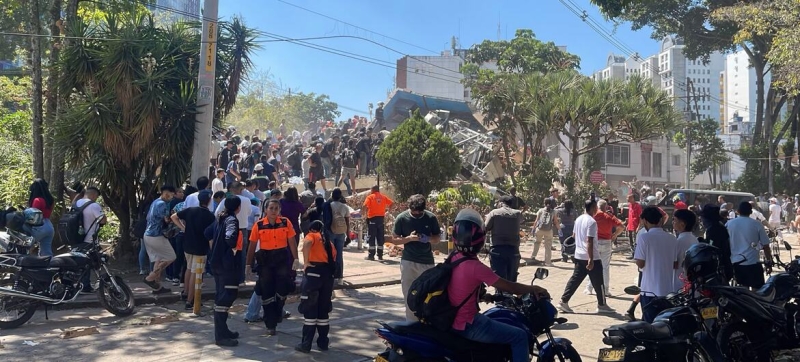

© V.-E. Salazar Rescuers work at the site of a building collapse in Columbia. Earthquake in Colombia: mutual aid and solidarity amid ruins Laura Quinones Humanitarian aid
In Cali, one of the cities hardest hit by Colombia’s recent earthquake, hundreds of people are still waiting for news of missing relatives, friends and neighbors. Rescuers search for signs of life under collapsed buildings, and ordinary residents help them, often clearing away the rubble with their bare hands.
The UN sent teams of specialists and resources to support the rescue operation and provide first aid to the victims.
“An incredibly tense moment”
When the building where Victor Manuel Rodriguez lives began to shake, he thought he might be experiencing the last moments of his life. Window glass shattered. Looking outside, he saw neighboring buildings beginning to collapse. He grabbed his dog and ran down the stairs.
“It was an incredibly tense moment,” recalls Victor. “It was very difficult for all of us to realize that this day could be our last.”
Victor spent several hours on the street while specialists checked the condition of the building. When he was finally allowed to return home, he put the apartment in order and began to collect everything that could be useful in an emergency: a flashlight, gloves, whistles and some of the camping equipment that he usually takes with him on hikes.
Then he went outside again, but this time to help others. Capri in the south of Cali, where several buildings collapsed. This area was familiar to him: the apartment complex in which he grew up was located nearby. In addition, he believed that one of his friends might remain under the rubble.
“We are waiting and hoping that she is alive,” he said.
An incomplete picture of the tragedy
Cali, Colombia’s third-largest city and capital of the department of Valle del Cauca, is in the center of the region hit hardest by the Aug. 10 earthquake 7.4 points.
According to official data collected by the UN Office for the Coordination of Humanitarian Affairs (OCHA), as of the afternoon of August 12, the department had registered 132 dead, 238 missing and more than 2,500 injured. Across the region, about 36 thousand were affected to varying degrees by the consequences of the disaster people.
However, these figures reflect only part of the overall picture. Children are waiting for news about their parents; neighbors ask each other about the fate of loved ones and acquaintances; Hour after hour, families hope to get some information about those still missing.
Victor spent most of Monday and early Tuesday morning with rescuers and volunteers. Sometimes the rescue teams asked for silence, and everyone froze, listening for any sound coming from under the pile of destroyed concrete. When signs of life were discovered, hope returned to those waiting nearby.
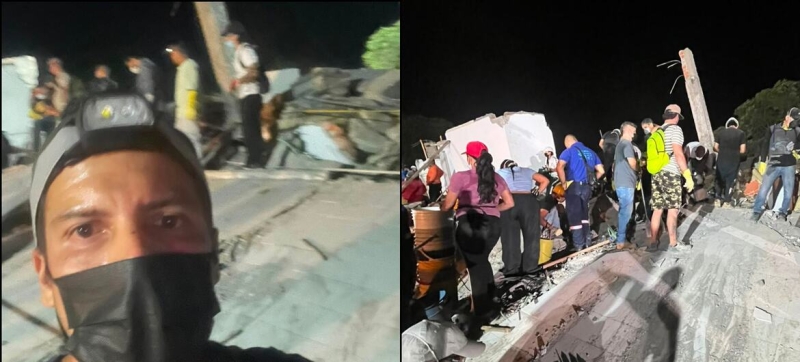
Victor Manuel Rodriguez Cali resident Victor Manuel Rodriguez went to help rescuers on the first day of the earthquake.
Victor recalls that he arrived shortly after a man was pulled out alive from the rubble. Then he saw two more rescued. The bodies of three victims were later found. The moment he returned home, he learned that the rescuers had managed to save another life. “I began to understand that the world was not limited to just my own family,” says Victor. “At these moments we are talking about everyone around us: about a neighbor, an acquaintance, a man living on a street corner, an elderly man who can barely walk.”
The city that came to the rescue
José Daniel Hernández joined the rescue efforts and cleared the rubble on the first day. When he went outside again the next morning, he saw dozens of people doing the same: some bringing things needed to the victims, others waiting for the opportunity to provide at least some help at the damaged buildings, others asking the rescuers how they could be useful.
Jose spent several hours moving around the city and trying to find a place where his help would be needed. When there were already enough volunteers at the rescue sites, he switched to other tasks: delivering fuel for the equipment to operate at night, batteries, flashlights and cutting tools.Jamie Selemyn has seen community mobilization efforts across the city. What struck her most was that people from all walks of life were doing the same thing: buying water and food with their own money, bringing helmets, goggles, gloves and shovels to rescue sites, or spending long hours at aid collection points. They sorted donations, helped affected families and those who continued to work among the rubble.
In Cali at that time there was intense heat: the air temperature was approaching 35 degrees Celsius. According to Jamie, in such conditions, delivering water and food to firefighters, rescuers and volunteers became almost as important a task as collecting everything they needed.
Interrupted Festival
One of the premises converted after the earthquake to collect humanitarian aid was originally prepared to host one of Cali’s most important cultural events. Every August, the Petronio Alvarez Festival brings together the music, cuisine, crafts and traditions of Colombia’s Pacific region, which is closely tied to the city’s identity.
The festival opened on Sunday and was supposed to last a full week, but Monday’s earthquake halted the celebrations. The festival grounds, as well as areas intended for musicians, traditional cuisine masters and visitors, are now being used to sort aid to the affected communities.
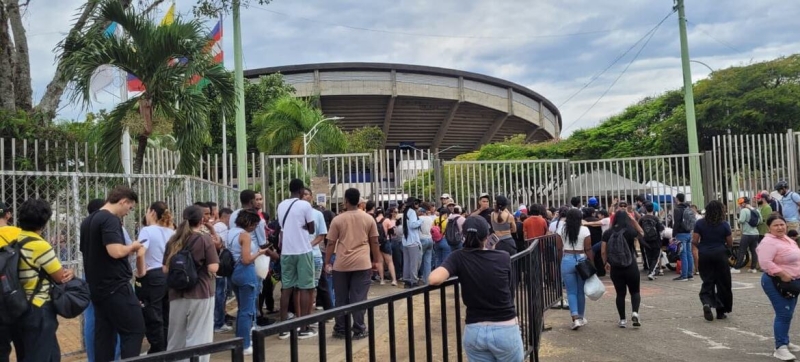
© J. Selemin A line of people willing to donate basic necessities to earthquake victims.
Some relief collection sites in Cali eventually began asking people to stop bringing certain types of items and redirect aid to where it is most needed.
“It makes me feel a little better to know that there are people who are supportive and helpful,” Jamie said. – For me, mutual assistance became the most important thing in this tragedy. We must also acknowledge the work of the firefighters. There are not many of them, but they give their all. And now that rescue teams from other regions are arriving to help, I hope that those still trapped under the rubble can be pulled out alive.”
“How can I help?”
As rescue teams continue to search for survivors, the scale of the emergency becomes increasingly serious. Thousands of families lost their homes or saw their homes destroyed or seriously damaged. These people now need temporary shelter, medical care, safe drinking water, food and psychological support.
In Valle del Cauca, the UN Office for the Coordination of Humanitarian Affairs has identified medical and psychosocial assistance, safe water, and child protection as its top priorities.
UN Emergency Relief Coordinator Tom Fletcher announced the release of five million dollars from the Central Emergency Response Fund (CERF) to support immediate efforts.
As the search for survivors continues, the UN is already thinking about the next phase. According to the UN Resident Coordinator in Colombia, Maria José Torres Macho, recovery should not be just about restoring what has been lost.
“This should be an opportunity to realize the principle of ‘building back better,’” she says.
Crises test societies, but at the same time demonstrate the ability to unite and unite, Torres Macho said. move forward. In Cali, this unity was visible from day one: it was a city full of people who asked again and again: “How can I help?”