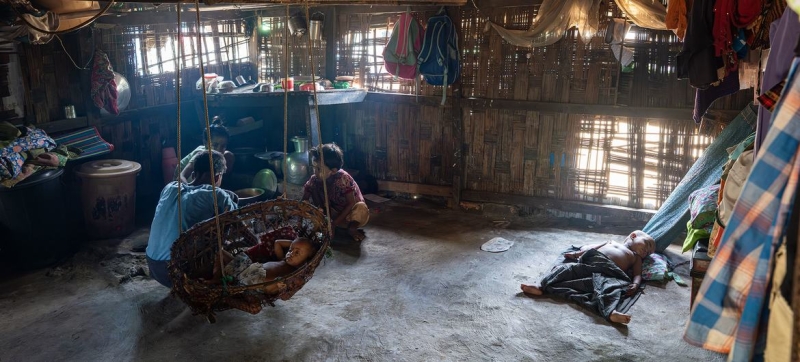

© WFP IDP camp in Myanmar. UN investigative mechanism: Myanmar military deliberately attacks civilians Human rights
Myanmar’s military continues to carry out targeted attacks on civilians, including airstrikes on homes, schools and camps for internally displaced people. Civilians are also victims of arbitrary detention, torture and sexual violence. This is stated in the annual report of the Independent Investigative Mechanism on Myanmar.
The report covers the period from July 2025 to June 2026.
Strikes on schools and hospitals
“One of the areas we are focusing on, given the suffering that is happening in Myanmar, is airstrikes [on civilians]… We are looking at the command structure and how such airstrikes could be ordered,” said Mechanism head Nicholas Koumdjian. According to him, schools are especially often targeted.
“Children often become victims of these airstrikes. Hospitals are also being hit. Our team is collecting evidence of where these attacks took place and what kind of munitions were used,” he said.
Myanmar has been engulfed in conflict since February 2021, when the military seized power, overthrowing the civilian government and arresting the country’s top leadership, including President Win Myint and State Councilor Aung San Suu Zhi.
After the coup, mass protests broke out throughout the country, which subsequently developed into armed resistance. Today, armed groups opposed to the military control large parts of the country.
Attacks have intensified
According to the report, attacks intensified in the run-up to elections in January and have continued unabated since. UN experts have documented attacks on homes, schools, medical facilities, religious sites and camps for internally displaced people. They were also able to establish the involvement of some units of the armed forces in these attacks.
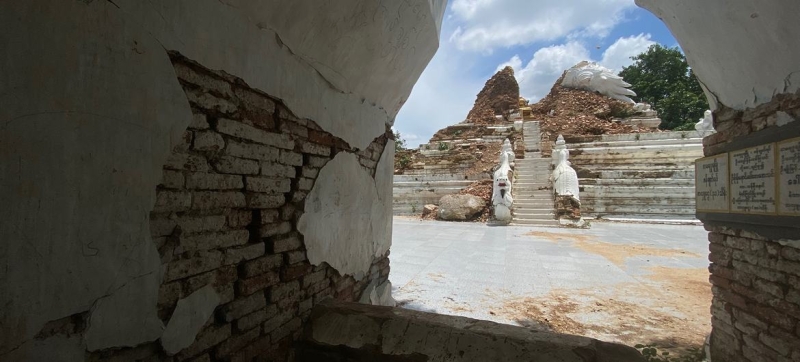
© UNOPS/KMT The Myanmar army carried out airstrikes in the center of Magway (file photo).
The report notes that the military is increasingly using motorized paragliders and drones. As a result, civilians have less time to notice an approaching threat and take cover.“Behind every piece of evidence we find are people whose lives were destroyed by these crimes,” Kumjian said. Numerous cases of torture and sexual violence have been documented in places of detention under military control. In particular, we are talking about cases related to the law adopted in 2025, which provides for criminal liability for criticizing elections. According to this law, people who publish critical comments on the Internet face up to 20 years in prison or the death penalty.
While much of the evidence collected concerns the actions of military and associated armed groups, the Mechanism also investigates abuses allegedly committed by armed groups opposed to the military regime.
The report’s findings are based on information from more than 1,600 sources, including over 750 witness statements, as well as photographs, videos, and forensic evidence. examinations and satellite imagery.
Independent Investigative Mechanism
The Independent Investigative Mechanism for Myanmar was established by the UN Human Rights Council in 2018 to collect and store evidence of the most serious crimes committed in the country since 2011, with a view to their use in future cases. judicial proceedings.
The Mechanism itself does not have the power to prosecute, but transfers the collected materials to national and international judicial authorities. These include the International Criminal Court, Argentine courts hearing cases of crimes against the Rohingya community, and the International Court of Justice, which is considering whether Myanmar violated the Convention on the Prevention and Punishment of the Crime of Genocide during the 2016-2017 anti-Rohingya campaign.
In 2017, then-UN High Commissioner for Human Rights, Zeid Ra’ad al-Hussein, called the exodus of hundreds of thousands of Rohingya to Bangladesh “a textbook example of ethnic cleansing.”