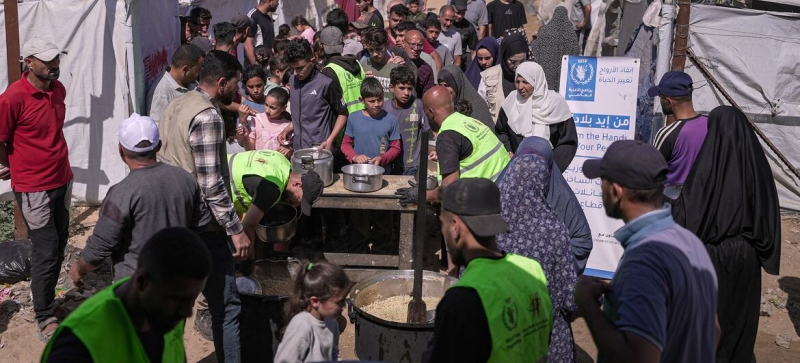

© WFP/J. Badwan The World Food Program is providing hot meals to families in the Gaza Strip. Gaza: 1.4 million people still face severe food shortages Humanitarian assistance
Despite some improvements in the nutrition situation in the Gaza Strip, 1.4 million people – about two-thirds of the population – still face severe food shortages. However, the situation may worsen if external support is reduced. This is stated in a new report from the World Food Program (WFP), covering the period from July 1 to July 31.
According to the Integrated Food Security Phase Classification analysis, the nutrition situation in the enclave has improved mainly due to humanitarian assistance rather than the restoration of markets or the food system. At the same time, support needs are expected to remain high until the end of 2026.In July, WFP provided food assistance to more than 945,000 people, who received food packages covering 75 percent of their caloric needs. The UN agency’s resources are now sufficient to maintain this level of support for a maximum of 1.1 million people per month until the end of September. Beginning in October, unless additional funding is forthcoming, the number of beneficiaries will be cut to 600,000 people per month and rations to 50 percent of daily caloric needs.
WFP reports a funding gap of $565 million over the next six months. economic recovery and market mechanisms where possible. In July, the Cash for Work program employed 487 people in sewing, carpentry and financial literacy activities. At the same time, cash assistance for the population of Gaza has already been reduced.
Bread, hot meals and child support
Last month, 28 bakeries receiving flour and diesel from WFP produced about 110,000 two-kilogram packages of bread daily. Another ten bakeries to which the agency provided diesel produced 48,500 kilogram packages for sale on the open market. WFP-supported kitchens prepared and distributed approximately 250,000 hot meals daily in 307 locations, including shelters and camps for internally displaced people. The organization’s partners also provided assistance to prevent malnutrition at 214 points, which was received by 293.9 thousand pregnant and lactating women, as well as children under five years of age. About 12,900 pregnant and lactating women received malnutrition treatment services at 110 sites.
As part of the fresh produce distribution pilot program launched on July 18, nearly 18,400 children received oranges, apples and milk.
Restrictions on aid delivery
The report emphasizes that the situation in Gaza remains extremely fragile. Changes in the position of the so-called “Yellow Line” of Israeli military control and ongoing hostilities are causing population displacement and disrupting humanitarian operations.
The Kerem Shalom crossing remains the only entry point for humanitarian and commercial cargo, limiting supply volumes and increasing transport costs to deliver goods to the northern part Gases.
Inside the enclave, the movement of humanitarian supplies continued to be hampered by the unstable security situation, restrictions on routes, congestion at checkpoints and restrictions on the movement of personnel.
WFP also continues to seek permission to import critical logistics equipment, including spare parts and motor oil.
Situation in the West Bank
In the West Bank, humanitarian needs continue to grow amid rising violence, displacement and instability, according to the report. From January 2025 to June 2026, more than 41,000 people were displaced by military operations, demolitions and settler attacks. In July, WFP assisted approximately 309,400 people in the West Bank. They received food vouchers, cash transfers and in-kind assistance.
In total, WFP assisted more than 1.8 million people in the Palestinian territory in July.