

Photo by Oxford University/J. Carnes World Youth Skills Day is celebrated on 15 July every year. How to Choose a Career That Can Withstand Change: Advice from a Columbia University Career Advisor Culture and education
Deciding on a future profession has always been difficult. However, today the rapid development of technology makes this choice even more difficult for young people. As artificial intelligence and other new technologies transform the job market, it will become increasingly difficult to predict which skills will remain in demand in the coming years.
World Youth Skills Day, celebrated annually on 15 July, highlights the importance of preparing young people for employment, decent work and entrepreneurship. This year’s theme, “Skills for a Shared Future,” poses an important question: how can young people prepare for a job market that is constantly changing? To find the answer to this question, UN News Service’s Leila Bilalova spoke with Francesca Fanelli, senior associate director for career development at Columbia University. She works with students and graduates to help them identify career goals and prepare for entering the job market.
LB: Ahead of World Youth Skills Day, there is a lot of talk about how to prepare young people for the job market in a rapidly changing world. With the development of artificial intelligence and new technologies, it is becoming increasingly difficult to predict how different professions will change. What, in your opinion, should young people consider when choosing a profession in order to remain in demand and successfully adapt to changes in the labor market?
FF: Artificial intelligence is truly changing hiring processes and the work environment itself. I believe that mastery of artificial intelligence tools has become one of the skills that employers are looking for today. They want to see that people coming to work know how to use these tools correctly and know how to formulate queries correctly to get truly useful results. Artificial intelligence should be used as an assistant, not as someone who solves a problem for you. Decisions are still made by the individual.
As for choosing a profession, in my opinion, it should still be based on your interests and abilities. But today’s young people also need to be more open-minded, more flexible and ready to adapt to change. We often advise students to apply for jobs in two to four different industries at once. This means considering several fields, organizations and positions in which they would be interested in working.
I also think it is very important to emphasize their human qualities. In resumes, cover letters and during interviews, don’t be afraid to show your personality.
Now it is really very difficult to make any predictions. I know that some college graduates are increasingly looking into blue-collar jobs because they still require hands-on work. Many believe that these are the professions that are less susceptible to automation.
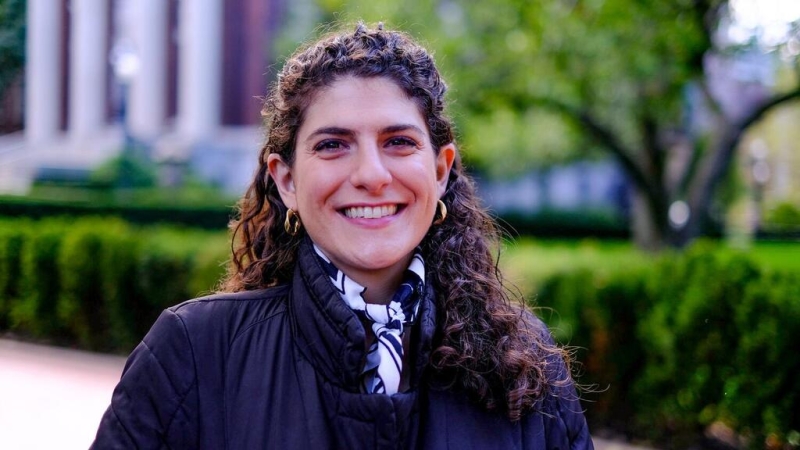
Photo from the personal archive of Francesca Fanelli. Francesca Fanelli is senior associate director for career development at Columbia University.
But it is impossible to say for sure which professions will truly be protected from the influence of AI. Therefore, in my opinion, it is important for young people to try themselves in different roles and acquire as many different skills as possible. Essentially, it’s about building a broad set of skills that can be applied across a variety of industries and roles.
LB: You mentioned that artificial intelligence can be a useful tool in the job search process. Can you share some practical tips on how young people can use AI in their job search?
FF: I think that artificial intelligence can actually be a very useful tool, and we encourage students to use various AI services to help themselves with preparing resumes, cover letters, etc. of course, with preparation for interviews.
One of the best ways to use AI is to first give it a specific role. First you need to find a vacancy for which you want to apply. Then you take that job description, feed it into the AI and say, “Imagine you are a qualified careers consultant” or “an experienced careers consultant.” Ask it to highlight keywords in the job description.
After that, you can ask the AI to help write a cover letter. He does a pretty good job of this task if he has previously analyzed the job description and highlighted the keywords. You can then upload your resume and it will update your cover letter with more specific information.
It is very important, however, to carefully read the resulting text. Make sure it sounds like something you would say and that there are no phrases you would never use yourself. This is important because I think AI has a pretty recognizable style.
When it comes to interview preparation, I myself use AI to come up with questions for students. If I’m conducting a mock interview, I feed the chatbot a job description and ask it to imagine itself as an experienced HR manager writing questions for the first 30-minute interview. He often offers very specific questions that allow you to evaluate a candidate in more depth, rather than being limited to the standard ones: “Tell me about yourself” or “Why do you want this job?.”
LB: As a career advisor at one of the world’s leading universities, you work with students every day. What problems do they most often come to you with when preparing to enter the job market? They understand that resumes may be scanned by artificial intelligence first, that it is becoming increasingly difficult to get to a human decision maker, that companies are receiving huge volumes of applications, and that they will likely have to send out a lot of applications before finding a job. This whole process seems very difficult.
In addition, students are very concerned about the lack of experience. I work with students from Columbia University – they have an excellent education, but not always enough practical experience. Therefore, many find themselves in a situation where they feel both overqualified and underqualified.
The first job after graduating from university is usually the hardest one to find. Sometimes students have to accept part-time jobs, internships, or multiple jobs to ensure financial stability. The job market is very competitive right now and there are fewer job openings, so it’s a really challenging time. A big part of my job — is helping people stay positive, build a search strategy, and make sure they can stick with that strategy for as long as it takes.
LB: It is probably especially difficult for those who have already received an education, but understand that their skills no longer meet the requirements of the labor market. UNESCO estimates that about 40 percent of the skills available today no longer meet current market needs. What advice would you give to people who have completed their studies but feel they need to adapt to a new situation?
FF: I think there are two important points here. First, it’s worth remembering that skills such as teamwork, collaboration, and effective communication still appear in almost every job. I see them in almost every job description. Most likely, these are the skills you develop during your studies. You just need to learn to explain to the employer that you really have them.
It seems to me that a lot depends on how you translate your skills into a language that an employer can understand. Almost any educational program teaches you to communicate, write, and work in a team. And here, for example, at Columbia University, many students also acquire research skills.
These are very broad, universal skills that can be applied in a variety of professions. Perhaps the job posting does not specifically state that research experience is required. But think about what exactly the research work gave you. You’ve learned to find information, analyze and synthesize it, and then communicate your findings to others, either orally or in writing.
So it’s important to think not only about the skill itself—such as research—but also about the specific activities that it involves. What tasks have you performed? What competencies have you acquired? And how can they be applied to another area? Think about your transferable skills and how to use them in a new role.
Secondly, if you realize that you really lack a particular skill, it can be acquired. But there are many other possibilities: you can take an online course, find a volunteer project where you can put new knowledge into practice, or agree with a colleague to learn a new skill together, using, for example, materials Internet.
LB: It turns out that throughout the entire job search dreams you really need to be flexible and find non-standard solutions.
FF: Yes, of course. But I also wanted to add that we try not to promote the idea of a “dream job.” In fact, even your dream job may not be what you imagined it to be.
I think it’s more important to find a job that is at least somewhat fulfilling. And, frankly, I don’t think at all that a person can find the whole meaning of his life only in work. It can be found in family, friends, hobbies, your community.
I try to remind people of this. Sometimes a job is just a way to ensure financial stability. And there’s nothing wrong with that. So don’t put too much pressure on yourself to make sure you find a job that you will absolutely love.