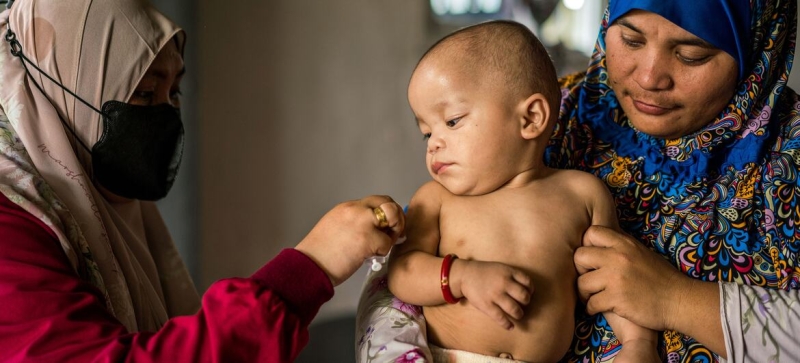

© UNICEF In 2025, 90 percent of the world’s infants will have received at least one dose of diphtheria-tetanus-pertussis vaccine. UN: Vaccination rates are rising, but the world faces new epidemics Health
Global efforts to vaccinate children are finally starting to bear fruit, with immunization rates slowly rising after a setback caused by the coronavirus pandemic. However, behind this cautious optimism lies an alarming reality: millions of children are still unprotected from outbreaks of measles and other dangerous diseases.
In 2025, 90 percent of infants—nearly 116 million—will have received at least one dose of diphtheria-tetanus-pertussis vaccine, according to an annual report published by the United Nations Children’s Fund (UNICEF) and the World Health Organization (WHO). 85 percent of babies completed the full course of three doses. This is one percent more than a year earlier, but still below the level of 2019.
The most vulnerable group is the so-called “zero-dose children,” who have not received a single vaccine. In 2025, their number dropped to 13.5 million, almost 750 thousand less than the year before. However, this progress is being undermined by another trend: a growing number of children who start a course of vaccination but do not complete it.
Help every child
An estimated 7.3 million infants received their first dose of diphtheria, tetanus and whooping cough but never received their first dose of measles. As a result, measles vaccination coverage has stagnated at 84 percent for the first dose and 77 percent for the second, far from the 95 percent needed to prevent outbreaks. Ultimately, 57 countries reported major measles epidemics in 2025.
“Global vaccination rates have recovered after falling during the COVID‑19 pandemic, but millions of children are still being left unprotected due to conflict, displacement and poverty – said Executive Director UNICEF Catherine Russell. She called for help every child and restore trust where it was undermined.
Geography vaccinations
The picture across regions is heterogeneous. South Asia and America have fully recovered their indicators and even improved them. Vaccination rates are rising in Africa, the Eastern Mediterranean and Europe, but these regions still lag behind pre-Covid levels. By contrast, the Western Pacific region has slipped back and is now the furthest away from 2019 levels.
More than half of all “zero-dose children” live in countries affected by conflict or political instability, although they contain only a third of the global child population. In such conditions, vaccination programs are collapsing literally before our eyes: Syria lost six percentage points in the first dose against diphtheria, tetanus and whooping cough and 12 points in the first dose against measles over the year. But there are positive examples: Sudan showed the largest progress in the world, raising first dose coverage for diphtheria, tetanus and whooping cough by 35 percent.
In middle- and high-income countries, the problems are different – political volatility, system failures and increasing parental hesitancy. South Africa has lost 20 percentage points in first doses for diphtheria, tetanus and whooping cough since 2019. And Bosnia and Herzegovina, after a record increase in measles vaccination coverage in 2024, fell by 23 points in 2025.
“Every child – whether born in peace or war – deserves the protection that vaccines provide,” said WHO head Tedros Adhanom Ghebreyesus. “This is one of the most reliable and fair ways to keep children healthy.”
“For everyone, everywhere and at any age”
Over the past 25 years, the number of “zero-dose children” has decreased by 40 percent thanks to investment, effective medical work and building trust in society. But the foundation on which this progress was built is beginning to crack. International health funding is dwindling, and data collection systems – a key tool for identifying unvaccinated children – are deteriorating. Countries reported results from just 18 national vaccination surveys in 2025, a third less than the year before.
UNICEF and WHO warn that without urgent action, the world will not be able to achieve the global strategy’s central goal of reducing the number of “zero-dose children” and ensuring access to vaccines for everyone, everywhere, at all ages.