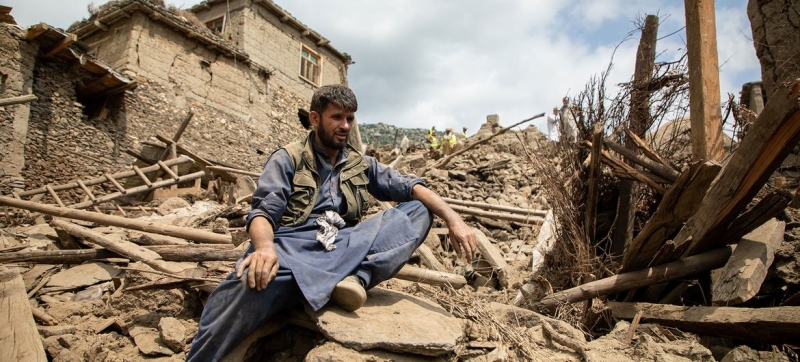

© UNICEF/A. Mirzad The main lesson from recent major earthquakes is that it is important to prepare before the next disaster occurs. Prepare for the next earthquake: why you need to act early Climate and Environment
Earthquakes remain the deadliest of all natural disasters. From 2000 to 2023, they accounted for more than half of all deaths related to natural disasters. In the World Health Organization (WHO) European Region, millions of people live and receive health care in buildings that may not withstand strong earthquakes.
Istanbul is of particular concern. The city of more than 15 million people is located next to the North Anatolian Rift, one of the most active in the world. According to a study published in 2025, a fault section runs under the Sea of Marmara that could cause an earthquake of about seven magnitude. Scientists estimate that the probability of such an event in the Istanbul area in the coming decades is 40–60 percent.
However, the risk area is not limited to Turkey. The WHO European Region is home to two of the world’s largest seismic belts. Almost the entire territory of Kyrgyzstan and Tajikistan, as well as certain regions of Kazakhstan, Turkmenistan and Uzbekistan, along with the countries of the South Caucasus, belong to zones of very high seismic hazard. The Fergana Valley is especially vulnerable, where about 11 million people live in the territory of three states – Kyrgyzstan, Tajikistan and Uzbekistan.
The experience of devastating earthquakes in Turkey and Syria in 2023 showed how critical it is for hospitals to continue to operate after a disaster. If medical facilities fail in the first minutes after a disaster strikes, thousands of victims may be left without life-saving care.
WHO experts emphasize that preparation is much cheaper than dealing with the consequences. The UN estimates that building a new hospital to be earthquake-resistant increases the cost of a project by less than four percent, while retrofitting existing buildings can cost about one percent of their cost, while significantly increasing their chances of continuing to operate after an earthquake.
In addition to strengthening medical infrastructure, experts recommend maintaining emergency medical teams at constant readiness, conducting regular exercises, improving international coordination and paying special attention to protecting the most vulnerable populations – the elderly, people with disabilities and internally displaced persons.
As noted by the WHO, the main lesson from recent major earthquakes is that it is necessary to prepare before the next disaster occurs.