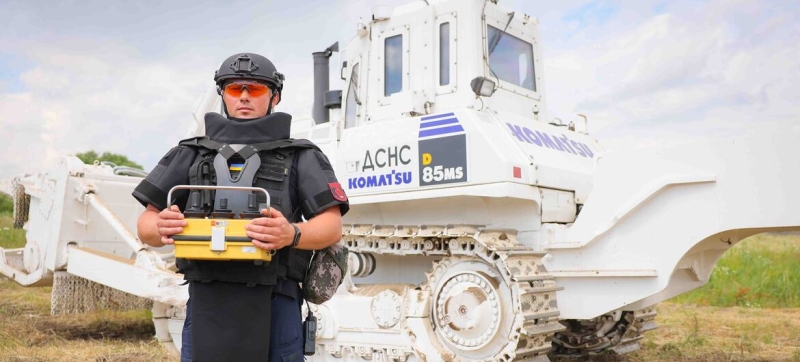

© UNDP-Ukraine/K. Nevenchenko Huge areas of agricultural land in Ukraine today are considered potentially contaminated, although some of it is actually safe. Ukraine: How drones and artificial intelligence are changing the future of humanitarian demining Peace and Security
The conflict on the territory of Ukraine has not only changed the nature of modern military operations, but also posed new humanitarian challenges to the world. The massive use of drones, artificial intelligence and new types of weapons has turned the country into one of the most mine- and unexploded ordnance-contaminated areas in the world. The consequences extend far beyond Ukraine: they affect global food security, the economy and the recovery of affected regions.
Paul Heslop, senior adviser to the United Nations Development Program (UNDP) on mine action in Ukraine, spoke about this in an interview with the UN News Service. According to him, the main factor that changed the battlefield was drones.
“The battle space has become much deeper, wider and much more deadly,” the expert explained.
If in the past the front lines were separated by several hundred meters, now the danger zone can extend to a depth of up to 20 kilometers. Any movement of a person or equipment is almost instantly detected by a drone, after which a strike is struck by artillery or a kamikaze drone.
According to Heslop, the casualty statistics have also changed. If previously there were usually three wounded for every one killed, today the situation is actually the opposite: “about three out of four combatants are killed, and one is wounded.”
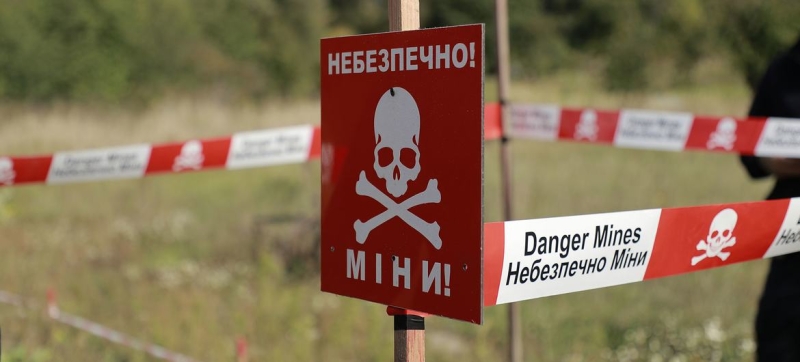
© UNDP-Ukraine/K. Nevenche “Caution – mines!”
Artificial intelligence makes weapons more accurate
Although many modern technologies remain classified, the expert noted that artificial intelligence is already playing an important role on the battlefield. It helps to quickly detect targets, select the most effective type of weapon and coordinate successive attacks with different systems.
At the same time, the nature of the mine danger is changing. Drones are increasingly being used not as independent weapons, but as a means of delivering conventional ammunition – mortar shells, grenades or rocket-propelled grenades. Such ammunition can explode immediately after falling, with a delay, or remain hidden on the ground, effectively turning into anti-personnel mines.
“Drones are revolutionizing the way weapons are used,” said Heslop.
This means mine clearance experts have to deal with much more varied and unpredictable threats.
Ukrainian experience and the courage of deminers
Despite the scale problems, Ukraine did not approach the current crisis from scratch. After World War II, Ukrainian specialists spent decades clearing the country of ammunition. From 1945 to 2022, more than half a million explosive objects were neutralized.
Today this work is continued by units of the State Emergency Service, police sappers, specialists of the State Special Transport Service, as well as Ukrainian and international humanitarian organizations.
According to Heslop, international experts support Ukrainian colleagues, while local specialists bear the brunt of the daily workload.
He is very impressed by the resilience of Ukrainian civilians. He recalls an incident in winter when a drone crashed into a residential building, but did not explode. The building was evacuated, sappers neutralized the device, and within two hours residents were able to return to their apartments.
“This level of resilience and ability to quickly solve problems is simply incredible,” the expert noted.
Demining is an investment in the future
Heslop emphasized that demining itself is not the end goal.
“If we clear an area of mines and it doesn’t produce a positive result, then the money is wasted,” he said.
Therefore, each operation is carefully evaluated in terms of its benefits. Cleaning the bridge could shorten a pregnant woman’s journey to the maternity hospital from four hours to fifteen minutes. Clearing the school will allow hundreds of children to return to in-person learning. Clearing one field can open up access to dozens more neighboring farmlands.
This is especially important for agriculture. Before the war, Ukraine was one of the world’s largest grain producers. Huge areas of agricultural land today are considered potentially contaminated, although some of it is actually safe.
A quick inspection of such areas will make it possible to return them to circulation, increase food production and thereby reduce world food prices.
According to the expert, an increase in the cost of bread by a few cents may be almost unnoticeable for residents of rich countries, but for families in countries with extremely low incomes, this means the inability to buy the necessary amount of food. Ultimately, food instability becomes one of the reasons for forced migration.
Technologies that will help the whole world
Paul Heslop believes that Ukraine today is becoming a platform for the creation of a new generation of humanitarian mine clearance technologies.
We are talking about modern satellite images, drones, highly sensitive sensors capable of detecting not metal, but the explosive itself, ground penetrating radar and robotic systems that allow you to examine dangerous areas remotely without exposing sappers to unnecessary risk.
In his opinion, Ukraine’s experience will benefit far beyond its borders. Technologies that are currently being developed for Ukrainian conditions will in the future be able to significantly speed up and reduce the cost of mine clearance in Afghanistan, Sudan, Somalia, Yemen and other countries where millions of people continue to live next to mines and unexploded ordnance.
“This is a battle that can be won,” the expert is convinced. According to him, “there is no magic wand,” but thanks to artificial intelligence and data analysis, limited resources can be used much more efficiently. “What could be achieved for $100 million five years ago can bring four to five times more results in the future,” Heslop noted.