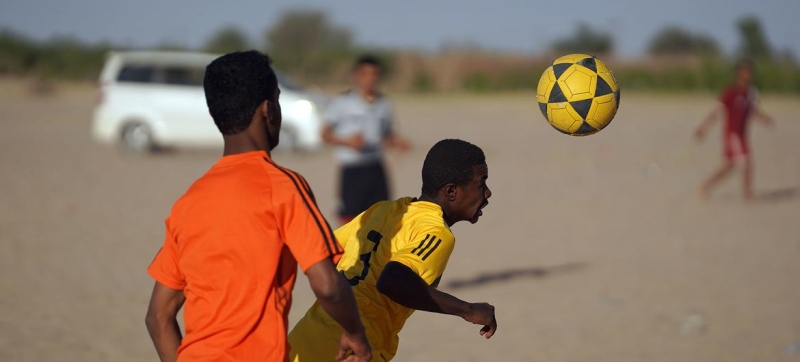

© IOM/X. Abdulbaki Poverty, armed conflict, and discriminatory regulations create significant barriers to sports participation for racial and ethnic minorities. UN expert: Racism and discrimination still widespread in sport Human rights
Racism, racial discrimination, xenophobia and related forms of intolerance remain widespread at all levels in sport. This was stated by the UN Special Rapporteur on contemporary forms of racism, racial discrimination, xenophobia and related intolerance Ashwini K.P., presenting her new report on this topic to the UN Human Rights Council.
“Sport has enormous potential to promote inclusion, equality and social cohesion. However, it continues to reflect and reproduce manifestations of systemic racism and racial discrimination that exist in society,” the expert emphasized.
The report finds that poverty, armed conflict, discriminatory regulations and underrepresentation pose significant barriers to sports participation for racial and ethnic minorities.
“Access to sport continues to be unequal. Socioeconomic inequalities, often rooted in historical and systemic racism, continue to disproportionately affect marginalized groups,” said the Special Rapporteur. athletes
Of particular concern, she said, are discriminatory eligibility criteria that often affect athletes from racially and ethnically marginalized groups. In addition, persistent stereotypes affect the identification of sports talent, the training and selection of athletes, as well as their perception by society. The report also highlights ongoing incidents of racist abuse and hate speech against athletes and fans both online and offline. The Special Rapporteur called on States to ensure equal access to sport, prohibit all forms of discrimination, combat hate speech more effectively and hold perpetrators accountable. She also recommended that sports organizations, the private sector and civil society strengthen inclusive governance, increase the representation of diverse groups and create a safe environment that respects the rights of all participants, including transgender people and intersex women. eliminate historical forms of discrimination. Only by overcoming the legacy of exclusion and inequality can sport fully become a force for promoting dignity, justice, inclusion and positive social change,” the expert emphasized.