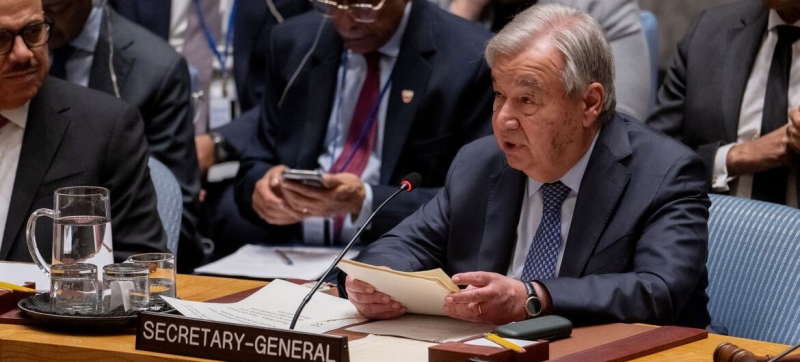

Photo UN/M. Elias Secretary-General Antonio Guterres speaks at a meeting of the Security Council. Guterres: UN Charter is “humanity’s hope for peace” Peace and Security
The UN Charter remains the “survival manual for humanity,” but today its principles are being seriously tested. This was stated by Secretary-General António Guterres, speaking at the high-level open debate of the Security Council on strengthening the international system based on the central role of the United Nations.
According to the Secretary-General, the UN Charter was created after the devastating world wars as a promise that “might shall prevail over the right of the strong,” and international disputes should be resolved by peaceful means.
Guterres recalled that the principles of this document for decades contributed to the prevention of a new world war, limiting the nuclear arms race, promoting human rights, decolonization and the development of states.
However, today, he emphasized, international law is increasingly ignored, and its violations continue unpunished.
Threats to the international system
The Secretary-General listed seven major threats facing the modern world.
Among them are the erosion of the principles of international law, deepening geopolitical differences, and the escalation of conflicts. According to Guterres, the world today is experiencing the highest number of armed conflicts since the founding of the UN.
“I am deeply concerned by the Russian Federation’s recent announcement of its intention to carry out sustained and systematic attacks on Ukrainian defense plants in Kyiv – as well as decision-making centers and command posts – following reports of a Ukrainian drone attack on a college building and a hostel in the Ukrainian city of Starobelsk, which is currently occupied by the Russian Federation,” said the Secretary General. “On Friday, we condemned the attack on the educational institution, just as we condemn all attacks on civilians and civilian infrastructure wherever they occur.”
“Today, more than ever, it is important to avoid further escalation of the conflict, which has already led to devastating consequences for the civilian population and risks further delaying the prospects for peace, prolonging the suffering of people,” he added. uncertainty surrounding negotiations between the United States and Iran aimed at resolving the conflict in the Persian Gulf region.
The UN chief also warned of a new arms race. Military spending has reached record levels, while lethal weapons are becoming cheaper and more accessible.
Especially alarming, he said, is the rapid development of artificial intelligence and autonomous weapons systems, which are outpacing the capabilities of international regulation.
The Secretary-General identified violations of human rights as another threat. he.
In addition, Guterres pointed to problems of sustainable development and the climate crisis, which is becoming a “threat multiplier” and a source of tension between states.
Reforms are needed
By According to the Secretary General, overcoming these problems requires efforts in the field of conflict prevention and peacekeeping, compliance with all norms of international law and reforms of international institutions.
He paid special attention to the reform of the UN Security Council.
“A Security Council that does not reflect modern geopolitical realities cannot fully fulfill its responsibilities,” Guterres emphasized.
He cited the lack of permanent representation of Africa on the Council as an example, calling it a “historical injustice” that undermines the body’s credibility and reduces its effectiveness.
Secretary-General called upon to strengthen the multilateral system as a whole and more actively use mechanisms for conflict prevention and peaceful settlement of disputes – negotiations, mediation, arbitration and other tools provided for by the UN Charter.
Political will
Secretary-General stressed that no institutional reforms can replace the political will of states.
He recalled that the UN Charter prohibits the threat and use of force against the territorial integrity and political independence of states, and also requires the resolution of disputes by peaceful means.
“The Charter remains humanity’s best hope for peace,” Guterres said. “But its strength depends on the commitment of those responsible for enforcing it.”
He concluded by calling on Security Council members to “act for peace,” restore trust through leadership and compromise, and ensure that the UN truly remains “a forum for solutions, a defender of international law, and a force for peace and security.”