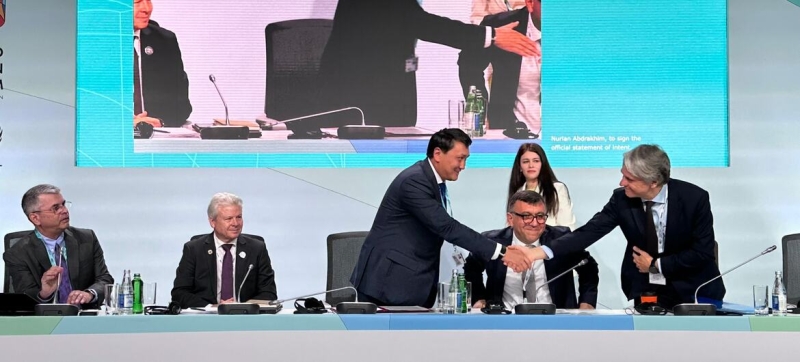

Photo by UN News Service The forum became one of the new regional projects presented at WUF13. Cities in Central Asia and Azerbaijan are expanding cooperation under the auspices of the UN Economic development
At the 13th session of the World Urban Forum (WUF13), held in Baku, a new platform for regional cooperation – the SPECA Cities Forum, created with the support of the UN – was officially launched. The initiators of the project hope that cities can become the main drivers of change in the region – from modernizing infrastructure to combating air pollution and climate risks.
Regional cooperation
The forum became one of the regional projects presented at WUF13 – the largest international UN platform dedicated to the issues of sustainable development of cities and housing.
SPECA is the UN Special Program for the Economies of Central Asia, launched in 1998 to strengthen regional cooperation, develop trade and integrate the countries of the region into the world economy. Azerbaijan, Afghanistan, Kazakhstan, Kyrgyzstan, Tajikistan, Turkmenistan and Uzbekistan are participating.
UNECE Forum of Mayors
Deputy Executive Secretary of the United Nations Economic Commission for Europe (UNECE) Dmitry Maryasin hopes that the Forum SPECA will become an integrated part of the Forum of Mayors, which has been functioning effectively for five years. This year, its main theme in this broader format will be sustainable infrastructure and the future of cities. “We are very proud of this format and hope that it will continue to develop in the future,” said Maryasin.
The importance of cities
It is no coincidence that the UN attaches increasing importance to the cooperation of cities, considering them “drivers of progress.” “It is there that problems are concentrated, and it is there that solutions, including innovative solutions, are very often concentrated,” he said in an interview with the UN News Service on the sidelines of the forum.
According to Maryasin, governments are not always ready to quickly agree on new approaches at the interstate level, while cities are capable act faster and implement practical solutions.
The SPECA Cities Forum was first initiated during the COP29 climate conference in Baku in 2024. Its founders were six cities in the region – Almaty, Arkadag, Bishkek, Dushanbe, Ganja and Samarkand. Now the platform has officially started working in full format.
Population growth and urbanization
The region is experiencing rapid urbanization. The UN estimates that the population of cities in Central and Western Asia has grown by about 35-45 percent over the past decade. This increases the burden on transport, housing, water supply and energy systems.
Against this background, cities in the region are increasingly looking for new approaches to development. The focus is on affordable housing, climate resilience, energy efficiency and infrastructure modernization.
“Smart City”
Maryasin emphasized that the concept of “smart city” is not always associated exclusively with digital technologies. “The word “smart” does not always mean the introduction of digital technologies or even innovations. Sometimes it’s about quality planning, about prioritizing, about understanding how various elements of infrastructure are interconnected,” he noted.
At the same time, technologies, including artificial intelligence and modern monitoring systems, are already helping cities solve practical problems. These include, for example, managing traffic flows to reduce congestion, more efficient water supply systems and air quality control.
Innovations and Initiatives
Air pollution remains one of the most pressing problems for many cities in the region. Dust storms, smog and traffic emissions are becoming a growing problem amid population growth and urban expansion.
Interesting initiatives are already emerging across the SPECA region, according to the UNECE representative. Among the examples discussed at the forum were projects in Ganja, Almaty and Arkadag, built in Turkmenistan as a new “smart city”.
Exchange of experience between cities
However, the large-scale transformation of the urban environment, according to him, is still only in the process. “Problems such as quality and aging infrastructure must be addressed at an accelerated pace. Smart investments are needed here,” Maryasin emphasized.
He noted that cities are actively learning from each other, adapting successful solutions to local conditions. What works effectively in one country cannot always be directly transferred to another.
As examples of successful transformations, he cited urban greening projects, the transformation of major highways into public spaces, and the development of so-called “active mobility”, where priority is given to pedestrians and cyclists rather than cars. called Copenhagen. However, according to Maryasin, the SPECA region is already developing its own successful practices. He specifically noted Baku’s experience in creating protected bicycle paths and expanding green areas.
SPECA Foundation
The SPECA Foundation, which has already begun its work, should play an important role in the implementation of the planned projects. According to Maryasin, the fund has received funding and announced the first call for applications from accredited UN agencies.
One of the key areas of funding is expected to be projects of “smart” and sustainable cities. UNECE also intends to develop cooperation with UN-Habitat, the UN agency working on sustainable urban development and housing.