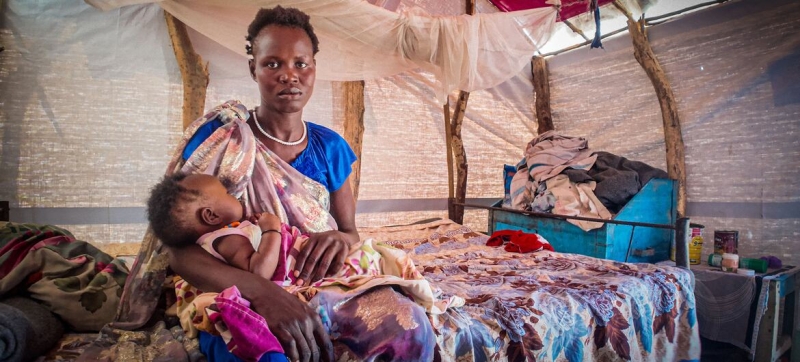

A South Sudanese woman forced to leave her home due to war South Sudan: deteriorating humanitarian situation and new round of violence Peace and Security
South Sudan finds itself at a dangerous crossroads: escalating conflict, mass displacement, famine and lack of funding have brought the country to the brink of disaster. This was stated in the Security Council by the UN Deputy Secretary General for Humanitarian Affairs Tom Fletcher and the Special Representative of the Secretary General, Head of the UN Mission in South Sudan Anita Kiki Gbeho.
The situation is getting worse
According to Fletcher, the situation is rapidly deteriorating in all key indicators. “The conflict is growing. The number of displaced people is growing. Hunger is getting worse. Diseases are spreading. Attacks on aid workers are increasing, while funding is dwindling,” he said.
Today, the UN estimates that two-thirds of the country’s population needs humanitarian assistance, but the response plan is only 22 percent funded.
The conflict is growing. The number of displaced people is growing. Hunger is getting worse. Diseases are spreading. Attacks on aid workers increase while funding dwindles
The situation is particularly difficult in Jonglei state, where more than 250 thousand people have been forced to leave their homes since the end of December, and over 110 thousand have fled to Ethiopia. The violence is forcing humanitarian organizations to flee areas, leaving people without life-saving aid. In the city of Akobo, where humanitarian missions had recently worked, warehouses were looted and nutrition centers destroyed.
Fletcher gave specific examples of the suffering of civilians. He told of a one-and-a-half-year-old child with gunshot wounds, of women whose homes were burned, and of families forced to flee while carrying the elderly and disabled. “This is what happens when parties to a conflict ignore their obligations to protect civilians,” he stressed.
The health situation is also critical: more than 1.3 million people have lost access to health care after dozens of facilities have been closed or destroyed in Jonglei state. Against this background, cholera and measles are spreading.
Food situation
The food situation is of particular concern. The UN estimates that more than 7.5 million people will need food assistance this year, with some regions already expecting levels of extreme food shortages. Fletcher warned that if the situation does not change, his next report may already be about famine.
Anita Kiki Gbeho, who gave her first briefing in her new role, confirmed that political, humanitarian and security issues are aggravating the situation. “Political tensions, rising violence and humanitarian needs are increasingly interconnected,” she said.
According to her, in the last period alone, the number of civilian deaths and injuries increased by 40 percent compared to the previous year. At the same time, almost 10 million people are in need of assistance, and access to them is complicated by insecurity and restrictions on the work of humanitarian organizations.
Lack of resources
Gbeho also drew attention to the decline in the Mission’s capabilities: due to lack of resources, operational capacity has decreased by 25-30 percent. This is forcing the UN to reduce its presence and re-prioritize, which may affect the protection of civilians.
Despite this, the Mission continues to play a key role – accompanying humanitarian operations, patrolling dangerous areas and facilitating access to justice. However, as the speaker emphasized, existing resources do not correspond to the scale of the challenges.
The need for peace
Both speakers agreed on the main thing: there is no military solution to the conflict. A political process based on dialogue and respect for peace agreements is needed.
Fletcher called on the Security Council to achieve unimpeded humanitarian access, increase funding and ensure respect for international humanitarian law.
Gbeho, in turn, emphasized the need for an immediate ceasefire and the launch of inclusive political dialogue as the basis for sustainable peace.
“Humanitarian assistance can save lives, but only peace can end this crisis,” concluded Fletcher