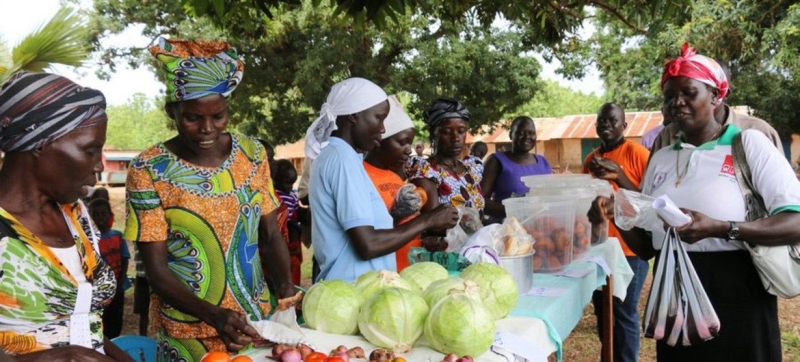

High food prices and hyperinflation have led to a sharp increase in the number of hungry people in South Sudan. There is strength in unity: developing countries unite amid economic turmoil Economic Development
Developing countries are looking to have a stronger voice in debt negotiations. The reason for optimism was the launch of a new interstate borrowers’ initiative, presented on Wednesday on the sidelines of the Spring Meetings of the International Monetary Fund (IMF) and the World Bank.
The economic echo of conflict in the Middle East is reverberating across the globe, from import-dependent Caribbean countries to Pacific island states. The sharp rise in oil prices triggered a chain reaction: food and essential goods became more expensive, hitting low-income families particularly hard.
Military escalation could push more than 30 million people around the world into poverty, according to a UN analysis.
In these circumstances, the creation of the Borrowers’ Platform – an initiative of UN member states supported by the United Nations Conference on Trade and Development (UNCTAD) – seems very timely. The problem that this project aims to solve has been brewing for years: over the past decade, the cost of debt servicing for developing countries has skyrocketed to critical levels.
Least Developed Countries Today give almost a quarter of their income to external creditors. Fifty-four nations, home to 3.4 billion people, spend more on debt payments than on health care or education. By 2024, the total external debt of developing countries has reached an astronomical level of $11.7 trillion.
Breakthrough in the global financial system
The platform is open to borrowing countries of any size, regardless of their level of development or debt burden. It will allow participants to share experiences and present a united front, and will strengthen their ability to collectively respond to debt problems.
At the unification’s presentation in Washington, UN Secretary-General Antonio Guterres (whose debt expert group proposed the idea in 2025) called the initiative “a breakthrough in the global financial system.” He compared it with such venerable associations of creditors as the Paris and London Clubs or the Institute of International Finance.
Guterres emphasized that borrowers are often simply not allowed to discuss their own debts. As a result, they are forced to pay interest rates that are on average twice those of advanced economies.
“This puts developing countries at a distinct disadvantage in finding the financing they need. “We have before us another clear example of the inequality inherent in the very foundation of the global financial architecture,” said the head of the UN.
Consequences of the war in the Middle East
The UN Secretary General specifically focused on the problems caused by the war in the Middle East. In addition to higher fuel prices, the conflict is leading to higher commodity prices, slower economic growth and broken supply chains.
According to him, the Platform will help borrowing countries:
- share expert knowledge in the field of debt restructuring;
- conduct dialogue with creditors on an equal footing;
- send clear market signals to lenders (which can lower borrowing costs);
- take center stage in future discussions.
“Developing countries are becoming significant players in the economy,” concluded Guterres, “and global governance must adapt to this reality.” systems.
Over the past ten years, the cost of servicing their debts has risen markedly, forcing governments to make a painful choice: the more money spent on paying creditors, the less available for social services and the fight against climate change.
The borrowers’ platform is changing the international financial architecture, creating a space where countries can share experiences and increase their collective influence on world system. This is an interstate initiative, the secretariat of which is performed by UNCTAD.