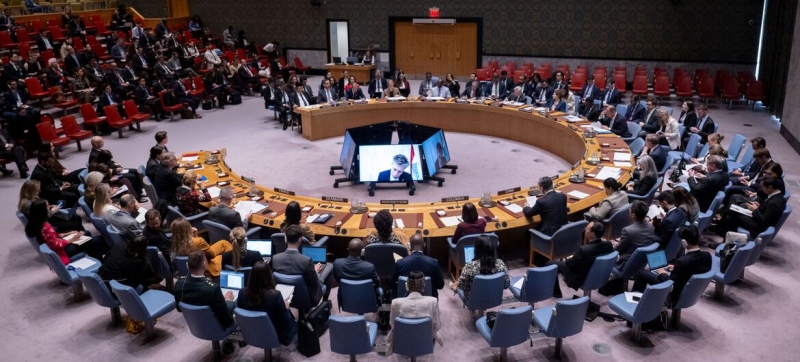

Security Council meeting on the situation in Lebanon. UN representatives in the Security Council: Lebanon is on the brink of disaster Peace and Security
Senior UN officials addressed the Security Council on Tuesday warning of the rapidly deteriorating situation in Lebanon as clashes between Israel and Hezbollah intensify, civilian casualties rise, and the deteriorating security situation negatively impacts peacekeeping and humanitarian operations.
“The Lebanese people did not choose this war”
Assistant Secretary-General for the Middle East Khaled Khiari said the conflict continues to expand and become more intense. Since the beginning of March, fighting in the Blue Line area has sharply escalated: Israeli troops are advancing deeper into Lebanese territory, and the incessant exchange of fire is causing widespread destruction.
According to the Lebanese authorities, 1,247 people in the country were killed and 3,680 were injured. Civil infrastructure was seriously damaged: medical facilities, schools and key transport arteries.
Khiari warned that the violence was not only destroying population centers, but also undermining Lebanon’s fragile internal stability. He noted that tensions between the Lebanese government and Hezbollah are increasing as the group continues military operations despite the ban imposed by the government.
“The Lebanese people did not choose this war,” he emphasized, recalling the recent statement of the UN Secretary General.
“There is no military solution. Only diplomacy, dialogue and full respect for the UN Charter and Security Council resolutions can lead to a sustainable peace,” he added.
Critical humanitarian situation
UN Emergency Relief Coordinator Tom Fletcher, speaking via video link from Beirut, described the humanitarian situation as critical.
Entire communities were forced to flee their homes: more than 1.1 million people were internally displaced, and over 200 thousand fled to neighboring Syria.
Fletcher highlighted the enormous strain on already weak infrastructure. Hospitals and health centers are closing or at capacity, schools are being turned into shelters, and destroyed bridges and roads have cut off entire regions.
Humanitarian agencies have ramped up aid efforts, delivering millions of meals, water, medicine and basic supplies. However, lack of funding and difficulties in accessing conflict zones make operations difficult. So far, only a fraction of the $308 million requested has been raised.
Fletcher emphasized that people want safety above all else. “They want this to stop. They want to break out of this vicious circle of crises,” he added.
The Emergency Relief Coordinator also warned of a possible long-term occupation of southern Lebanon by Israel and the risk of further escalation of the conflict in the region. helmets serving as part of the United Nations Interim Force in Lebanon (UNIFIL).
Lacroix confirmed that three Indonesian peacekeepers were killed in one day, and several more were seriously injured. The UN Secretary-General condemned the actions that led to the death of military personnel.
UN mission personnel report constant shelling, explosions and restrictions on freedom of movement. Lacroix said peacekeepers should never be targeted and called on all parties to respect the sanctity of UN facilities.
Meanwhile, the intensification of hostilities continues. Thousands of shells have been fired in recent days. According to reports, Israeli troops have advanced up to 11 kilometers deep into Lebanon. Civilians on both sides of the Blue Line remain targeted.
Despite all the difficulties, UNIFIL continues to help the population and maintain contacts with the parties to the conflict, trying to prevent further escalation.
The UN emphasizes the need for an immediate ceasefire and full implementation of resolution 1701 Security Council.