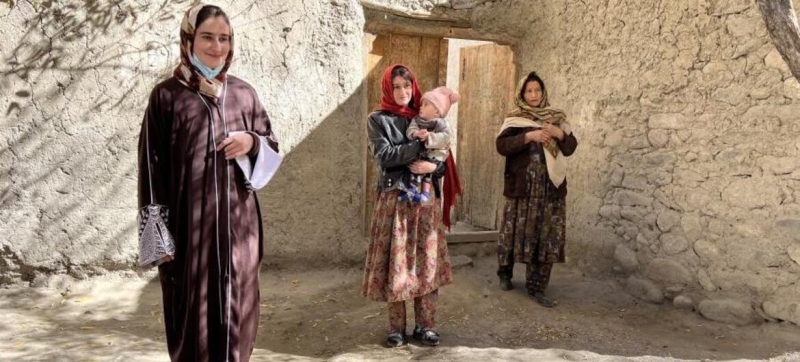

Afghan women and children receive humanitarian aid in rural areas. UN report: Afghanistan’s human rights situation is ‘rapidly deteriorating’ Human rights
The situation of Afghan people, especially women and girls, has continued to “rapidly deteriorate” since the Taliban took power in 2021. This is stated in the new report of the UN Human Rights Office for the period from August 2025 to January 2026, which was presented at the Human Rights Council in Geneva.
Some 21.9 million people – roughly 45 percent of Afghanistan’s population – will need humanitarian assistance this year, according to the document. The crisis is exacerbated by sharp cuts in international aid, the return of nearly three million Afghans from neighboring countries in 2025, and ongoing drought.
Women and girls pushed out of public life
“A string of decrees and laws passed by the de facto government since taking power in 2021 is having a devastating impact on the Afghan people, especially women and girls,” said UN High Commissioner for Human Rights Volker Türk, introducing the report.
Since 7 September 2025, Taliban security forces have barred Afghan women, including UN staff, contractors and visitors, from UN premises throughout the country. As of late January 2026, this ban remained in place, severely limiting the UN’s ability to operate in the country.
Women government employees who were ordered to stay home with reduced pay following the Taliban’s takeover in August 2021 were notified in January 2026 that their payments would be stopped and effectively laid off. The report notes that this happened with “minimal transparency, no due process and no mitigation measures.”
Girls are not allowed to study beyond the sixth grade. In November 2025, final exams in medical institutions were held without the participation of women for the second year in a row.
In addition to the ban on beauty salons, a number of provinces have tightened the requirements for women’s clothing as part of the “law for the promotion of virtue and the prevention of vice.” Although the mandatory wearing of the burqa appears to have been partially relaxed since mid-November, women who do not comply with the veil requirement continue to be removed from public transport and denied access to markets and services.
Books written by women have been removed from bookstores and libraries, including university libraries, regardless of their content or the nationality of the author. The teaching of human rights and gender studies was expressly prohibited.
“De facto authorities have effectively criminalized the presence of women and girls in public life,” Turk emphasized
“Afghanistan has become a graveyard of human rights”
The report also points out other violations that contravene Afghanistan’s international obligations, including public executions and corporal punishment. Since 2021, de facto authorities have carried out 12 public executions in stadiums, two of which occurred during the period covered by the report. Corporal punishment is carried out in public on a weekly basis.
At the end of September 2025, fiber optic connections were cut off throughout the country, cutting off Afghanistan’s access to the Internet and mobile communications for 48 hours. This has led to “serious and in some cases life-threatening consequences”, disrupting health services, emergency services, aviation and the banking system, as well as increasing restrictions on women and girls. No official reasons were given for the shutdown.
Journalists and media workers continue to face arbitrary arrests and detentions due to “disproportionate restrictions on published content.” From February 2025, live political talk shows are banned, and music and drama are excluded from television and radio broadcasts. The few remaining female journalists face additional obstacles, such as one being deliberately muted during a briefing in August 2025.
“Afghanistan has become a graveyard for human rights,” Turk said.
60~h2>Earthquakes and war actions
He added that millions of Afghans live in extreme poverty, without access to adequate food, clean water, education, health care and employment. Two earthquakes in late 2025 have deepened economic hardship, and cuts in humanitarian funding are “depriving people of their last line of support.”
In addition, the UN Assistance Mission in Afghanistan documented 70 civilian deaths and 478 injuries from cross-border incidents involving Pakistani forces in the last three months of 2025. These figures significantly exceed the scale of losses in previous years. The most difficult period occurred from October 10-17, 2025, when the escalation left more than 500 civilians injured.
Gender Apartheid
The UN Human Rights Office calls on the de facto authorities to immediately repeal all discriminatory decrees, restore women’s access to education and employment, establish a moratorium on the death penalty and then abolish it, end arbitrary detention, and ensure fair trials, respect for freedom of expression and full humanitarian access within the country.
The report also calls on other states to end refoulement Afghans, as deportees risk persecution, torture and other serious abuses. The international community is invited to support the new Independent Investigative Mechanism on Afghanistan established by the Human Rights Council to collect and preserve evidence of international crimes. “Accountability is critical and progress has already been made, including through the issuance of arrest warrants by the International Criminal Court in July 2025,” noted Turk.
In December 2025, the People’s Tribunal for Women of Afghanistan, organized by civil society, issued a symbolic decision finding the de facto authorities and the Taliban guilty of crimes against humanity, including gender-based persecution, gender-based apartheid, torture and arbitrary detentions.
“I fully support efforts to enshrine the concept of gender apartheid, along with other crimes, in the proposed Treaty on the Prevention and Punishment of Crimes against Humanity. A clear definition of gender apartheid is critical to its eradication,” Turk emphasized.