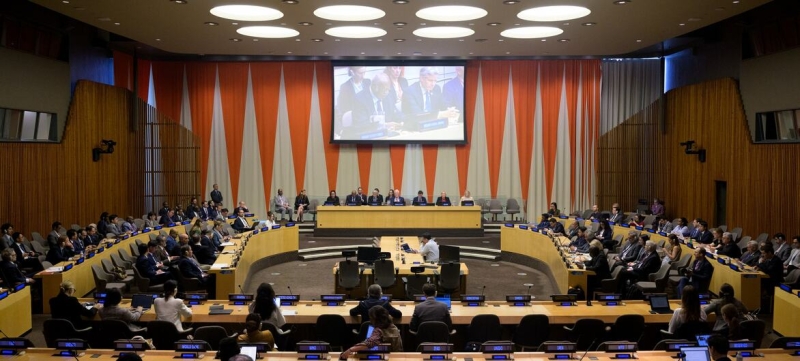

Meeting room of the Economic and Social Council. UN calls for global overhaul of credit rating system Economic Development
“Credit ratings and assessments paint a bleaker picture for developing countries than their economic reality deserves.” On behalf of the Secretary-General, his first deputy, Amina Mohammed, spoke with these words at a special meeting of the UN Economic and Social Council (ECOSOC) on Monday.
Credit rating is an assessment of a country’s solvency, which determines at what percentage it can borrow money on world markets. A low rating makes credit expensive or completely unavailable, hampering the economic development of countries.
Today’s ECOSOC meeting is part of the commitments enshrined in the Seville Agreement: countries, rating agencies and other participants in the financial system should regularly hold such discussions.
According to Mohammed, debt servicing is becoming an increasingly unsustainable burden for many developing countries today. It amounts to almost $1.4 trillion a year.
She noted the critical situation for the population: “More than 3.4 billion people live in countries that spend more on paying interest on their debt than on health care or education.”
The conflict in the Middle East, which has provoked higher prices for fuel and raw materials degrees undermine the financial stability of developing countries and their access to credit.
The situation is aggravated by the fact that current assessments often do not take into account the long-term potential of states. “These ratings and assessments systematically overestimate the risk, often not reflecting the fundamentals, progress and long-term potential of these countries,” the First Deputy Secretary General emphasized.
“Too often these rankings are static, short-term focused and often based on incomplete information, which limits a country’s ability to access financing at affordable rates,” she added.
The UN suggests three approaches to changing the system, starting with a transformation of thinking. “We must transform thinking from long-term speculation to long-term investment,” Mohammed urged, adding that risk analysis must include scenarios and probabilities, capturing opportunities as well as vulnerabilities.
The second approach involves redefining measures of success beyond GDP. “GDP tells us the value of everything and the value of very little. Financial decisions – including credit ratings – should not be based solely on profit and loss figures,” she said.
Mohammed also suggested reviewing the “sovereign ceiling” that limits private sector ratings within a country. According to Mohammed, “it is time to reconsider the sovereign ceiling, which may unfairly limit the credit rating of private sector debt, distorting risks and deterring investment.”
The third pillar of reform should be the accountability of all parties, including agencies and investors.
Finally, Mohammed emphasized that credit ratings should be a tool progress: “It’s time to transform credit ratings from barriers to tools for long-term financing and sustainable development.”