

© UNODC Captagon is an illegal drug common in the Gulf countries. UN report: global drug markets are rapidly transforming Peace and Security
Drug traffickers are effectively using new technologies and taking advantage of global instability to introduce new types of drugs. Criminal networks are experimenting with alternative trade routes and methods, and are aggressively moving into new markets. This is stated in the World Drug Report 2026, released today by the UN Office on Drugs and Crime (UNODC).
An estimated 331 million people used drugs in 2024, representing 6.2 percent of the global population aged 15 to 64 years. For comparison, in 2014 this figure was 5.2 percent. Cannabis remains the most widely used drug by a wide margin, with 256 million users in 2024. This is followed by opioids (63 million), amphetamines (32 million), cocaine (25 million) and ecstasy (21 million).
“We are seeing an unprecedented surge in new types of drugs entering the market and, alarmingly, some of them are even more potent and dangerous than before,” said UNODC Executive Director Monica Juma.
According to her, this is already leading to dire consequences, including millions of premature deaths and irretrievably lost years of healthy life of the population. Drug trafficking and use disrupt economic processes, destabilize the situation and contribute to violence.
“The need to focus on disrupting the activities of organized crime groups is greater than ever. We must intensify preventative measures, increase information sharing and coordinate joint operations, while increasing investment in prevention and treatment,” Juma stressed. deceive law enforcement agencies. Five times more types of drugs were seized in 2024 than in the period before 2000. For example, the number of new psychoactive substances circulating in drug markets reached 755 in 2024, with 118 of these substances being registered for the first time.Afghanistan’s 2022 drug ban continues to severely restrict the illicit production of opium and heroin. Although Myanmar’s production increased from 420 tons in 2021 to more than 1,000 tons in 2025, this growth (as well as the market in other UNODC-monitored countries such as Laos and Mexico) does not offset the decline in Afghanistan, which produced more than 6 thousand tons of opium in 2022.
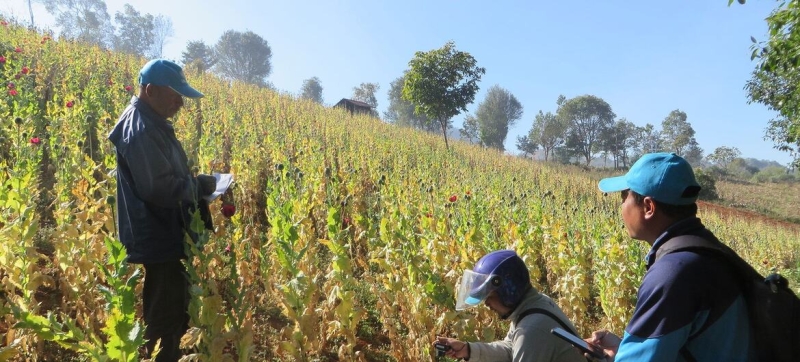
© UNODC UNODC staff conduct assessments in an opium poppy field in Myanmar.
The increasing availability of new synthetic opioids such as fentanyls, nitazenes, and orphins indicates that traffickers are seeking alternatives to heroin. The shift away from plant-based opiates in favor of synthetic ones could cause a permanent shift in the global opioid market, changing patterns of consumption and associated harm.
The methamphetamine market has gone global
New smuggling routes and the gradual expansion of methamphetamine production have created new markets, especially in the Near and Middle East, Africa and parts of Europe. Seizures grew at an average annual rate of 12 percent, with growth driven primarily by East and South-East Asia. Although Myanmar remains the main source of methamphetamine, high demand has also attracted suppliers from North America, West and South Africa, and Southwest Asia.
Methamphetamine from North America is now crossing the Pacific Ocean to countries in the Western Pacific region, causing an increase in trafficking and consumption in the Pacific Islands. In the Middle East, the destabilization of the Captagon market following the fall of the Assad regime in Syria and the subsequent doubling of the drug’s price in some places may lead Captagon users to switch to methamphetamine, the use of which has already increased in the region.
Shifting perceptions of cannabis are driving growth consumers
The production, trafficking and consumption of cannabis are evolving. This is likely due in part to ongoing changes in attitudes towards the drug at a time when many jurisdictions (especially in North America) have adopted legalization and/or decriminalization policies.
The number of people using cannabis has increased by 40 percent over the past decade, and the prevalence of its use has increased from 3.8 percent of the population aged 15–64 in 2014 to 4.8 percent in 2024. Cannabis seizures in 2024 also reached an all-time high.

© Unsplash Legalizing cannabis products reduces risk perception.
Historically, most cannabis trafficking has occurred within regions, largely because it can be grown almost anywhere. However, interregional trade involving North America is growing, with 57 countries or territories outside North America reporting it as the region of origin for seized cannabis between 2015 and 2024 (compared to just 11 countries in the previous decade).Cocaine production continued to rise in 2024, more than quadrupling over the past ten years to an estimated total of more than 4 thousand tons (pure). This is primarily due to increased productivity and increased cultivation area.
Organized crime groups continue to target increasing volumes of cocaine into both traditional and emerging markets in an effort to maximize profits and expand their customer base beyond the largest and most established markets in Western and Central Europe, North America and Oceania.
Evidence of this expansion is seen in Africa and Asia, where, despite relatively small volumes, some countries recorded the highest rates of increase in cocaine seizures in the world between 2020 and 2024.
The impact of drug use on safety
Drug use can be associated with committing crimes for personal gain and violence within families and social groups. Drug users can both become victims of crimes and commit them. However, this is influenced by factors such as the context of drug use and people’s personal history (including poverty, homelessness, mental health problems), as well as the situation in the community, such as lack of access to drug treatment and social services. These factors should be considered as starting points for interventions and preventive measures.