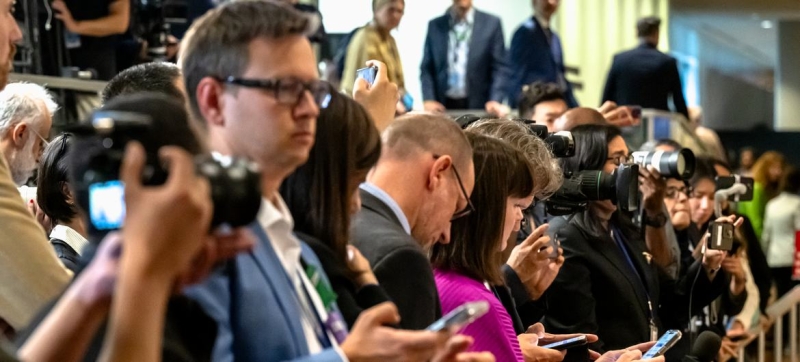

Photo UN/M. Garten The UN calls for protecting the rights of journalists. World Press Freedom Day: 85 percent of crimes against journalists go unpunished Human rights
“In war, the first casualty is truth.” UN Secretary-General Antonio Guterres recalled this catchphrase in connection with World Press Freedom Day, which is celebrated on May 3. He noted that “often the first victims are journalists who risk everything to bring this truth to people.”
The head of the UN added that this happens not only in war, but also everywhere where “the authorities are afraid of close attention.”
“Media workers around the world are at risk of censorship, surveillance, prosecution and even death. The number of journalists killed in war zones, often as a result of deliberate attacks, has risen sharply in recent years,” he said.
Eighty-five percent of crimes committed against journalists go uninvestigated and unpunished, he said Secretary General.
“All freedom depends on freedom of the press. Without it, we cannot talk about human rights, sustainable development, or peace,” said the UN chief. Guterres called for protecting the rights of journalists.
14 journalists have died in the world this year
UN High Commissioner for Human Rights Volker Türk recalled that 14 journalists have been killed in the world this year, and about 330 media workers are under arrest guards.
“Media workers have had their cars blown up, kidnapped from their offices, silenced, jailed, and fired from their jobs,” the UN’s top human rights activist said.
The greatest danger to journalists is covering war. Almost 300 journalists have been killed in Gaza since October 2023. In 2026, Lebanon became the most dangerous country for media workers.
“In Sudan, I met journalists who faced extreme violence, cruelty and even hunger – and still tried to do their job,” Turk said.
Beyond conflict zones, investigative journalism exposing corruption, crimes against environment or organized crime, pose serious risks to media workers and sometimes to their families, as in Mexico.
“What would a world look like without a free press? It would be a world of indifference, where violence is met with silence. A world of manipulation, where the truth becomes a subject of bargaining and is sold as a commodity. A world in which people would not be able to distinguish fact from fiction,” Turk said.
He emphasized that a free press is the “oxygen” of an open society. Countries must end the harassment of journalists, lift all restrictions on their activities, prevent attacks on media workers and protect them from surveillance.
“I call on states to investigate all violations and bring those responsible to justice,” concluded the High Commissioner.