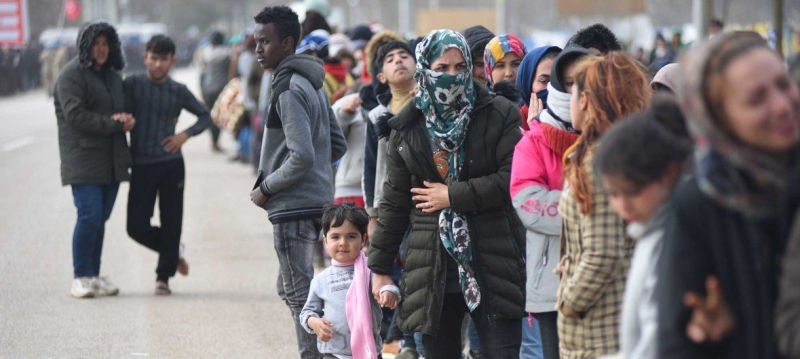

© UNICEF/O. Ocher Refugees and migrants on the border between Turkey and Greece. UN report: Women make up the majority of migrants in Europe and Central Asia Women
Women are increasingly shaping migration patterns in Europe and Central Asia, according to a new UN Women report released on Friday. They currently make up 54 percent of all migrants in the region.
“Profound changes” in migration processes
Today, more than 13 million women born in Europe and Central Asia live outside their countries of birth, and the region itself hosts over 9.5 million migrant women from all over the world. Report “Women on the Move in Europe and Central Asia: A Comparative Analysis of Mixed Migration, Structural Constraints and Opportunities shows that women are increasingly making the decision to move on their own in search of education, decent work, security and economic opportunity, rather than just accompanying other family members. This indicates profound changes in migration processes in the region.
Geopolitical context
These changes are occurring against the backdrop of full-scale war in Ukraine, geopolitical shifts in the South Caucasus, the ongoing effects of conflicts in the Western Balkans, and the increasing impacts of climate change, including floods, droughts, earthquakes, shortages water and extreme heat.
“For too long, migration has been seen as something independent of gender. This report tells a very different story, says Belen Sanz-Luque, UN Women’s regional director for Europe and Central Asia. – Across Europe and Central Asia, women are increasingly driving migration – as students, workers, carers, entrepreneurs, refugees and leaders of their communities. Sometimes migration becomes an escape from conflict, violence or natural disaster. Sometimes – a path to education, decent work and new opportunities. Whatever the reason, women deserve safe, rights-based migration mechanisms that take into account their real needs. Migration has a female face. It’s time to admit it.”
Gender inequality
The report highlights that while migration opens up new opportunities for women, they still face structural inequalities that limit their rights, economic security and access to protection. Women are increasingly moving abroad for study and work. More than half of Western Balkans and Turkey students studying abroad are women, many of whom go on to pursue careers abroad after graduation. However, even highly educated migrant women often cannot find work that matches their qualifications. Thus, almost 45 percent of female migrants from North Macedonia, 50 percent of Albania and ~60>55 percent of Kosovo women have higher qualifications than their current work requires.
Fields of employment
Migrant women remain concentrated in low-wage and precarious employment. The aging population of European countries is increasing the demand for female migrant workers in home care, long-term care for the elderly, hospitality and retail trades. From 30 percent of female migrants from Kyrgyzstan to 50 percent of female migrants from Tajikistan work in these sectors, where employment is often informal, poorly paid and with little protection. This increases the risk of exploitation, hazardous working conditions and gender-based violence. In Turkey, women make up a significant portion of the migrant population, but they account for only 27.2 percent of work permits issued.
Conflicts continue to change the region’s migration landscape. Between 2022 and 2024, women made up 61 percent migrants from the Republic of Moldova and 56 percent migrants from Ukraine who arrived in the countries of the European Union. In Ukraine itself, nearly 60 percent of internally displaced families are headed by women, reflecting the disproportionate impact of war on their lives and livelihoods. Human trafficking remains a hidden crisis. In 2022, women and girls made up ~60>74 percent of identified trafficking victims in Albania, 93 percent – in Kosovo, and ~60>81 percent
– in Montenegro.
Women and girls from marginalized groups, including Roma, are at particularly high risk, and their access to protection, justice and long-term support often remains limited. In the South Caucasus in 2023, at least ~60>112 women
were identified as victims of human trafficking. In Turkey, between 2019 and 2023, women and girls made up ~60>82 percent of all identified victims of human trafficking, including ~60>266 girls. More than half of the reported cases involved sexual exploitation, with labor exploitation in second place.
Climate Change
Climate change is becoming an increasingly significant factor in women’s migration. Droughts, floods, environmental degradation and extreme heat are increasingly forcing people to flee their homes. By 2050, climate-related disasters are projected to displace up to 2.4 million people in Central Asia.
Report authors’ recommendations
Report authors urge governments and international partners to improve migration policy taking into account gender factors. Recommended measures include expanding safe and legal migration routes, strengthening labor protections for migrant women, better recognition of their skills, investing in gender-sensitive social protection systems, and ensuring the full participation of migrant and refugee women in decisions that affect their lives.