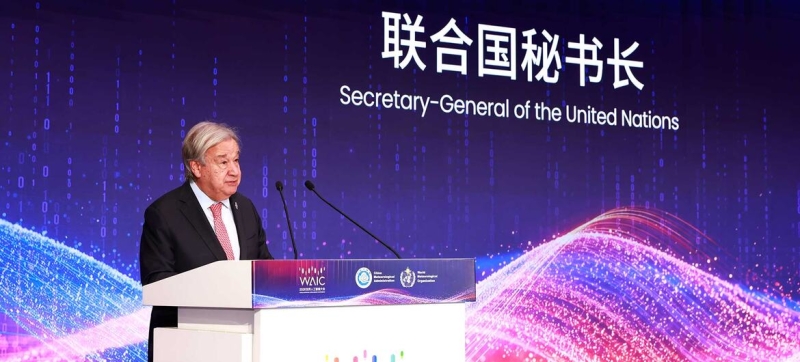

Photo of the UN in China UN Secretary-General Antonio Guterres speaks at the World Artificial Intelligence Conference (WAIC). UN Secretary General in China: artificial intelligence should serve people, not increase global inequality Culture and education
UN Secretary-General Antonio Guterres on Friday called for artificial intelligence to be made a tool for universal development, and not a source of new global gaps. Speaking at the opening ceremony of the World Conference on Artificial Intelligence in Shanghai, and then at a special forum on early warning systems for climate hazards, the UN chief emphasized that new technologies can save lives, but their benefits must be available to all countries.
At the opening of the conference, in which Chinese President Xi Jinping took part, Guterres noted that artificial intelligence opens up enormous opportunities for humanity, but at the same time carries serious risks.
“The technology that will determine the future of humanity must be shaped by all of humanity. It cannot be controlled by just a small group of countries or companies,” said the Secretary General.
The technology that will shape the future of humanity must be shaped by all of humanity
According to him, this is precisely the approach enshrined in the Global Digital Compact, adopted by the UN General Assembly with the support of China.
The UN chief warned that without international cooperation, artificial intelligence can only exacerbate existing inequalities. Today, a third of the world’s population still lacks access to the Internet, and computing power, data, and technical expertise are concentrated in a limited number of governments and companies.
We cannot allow artificial intelligence to push the world toward greater inequality
“We We cannot allow artificial intelligence to push the world towards greater inequality [… ], towards deeper gaps in income, opportunity and security between North and South,” he said.
Guterres said that more than twenty countries, including China, have already responded to his proposal to create a UN-backed Global Network for the exchange of experience and cooperation in the field of developing AI capabilities for developing countries. In addition, in the near future he intends to present recommendations on the creation of a Global Fund for Artificial Intelligence.
The Secretary-General also outlined three key areas of international cooperation: developing the potential of developing countries, creating common international safety standards and reducing the environmental consequences of the use of artificial intelligence. He called on major companies to disclose the full environmental footprint of their systems and convert their data centers to renewable energy by 2030.
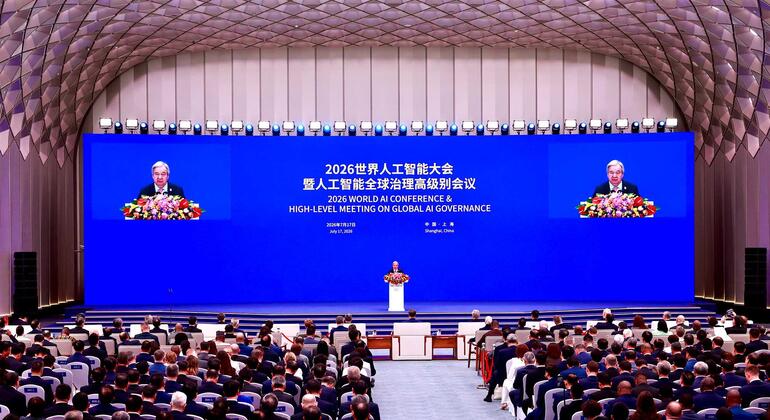
Photo of the UN in China Speech at the 2026 World Conference on Artificial Intelligence in Shanghai, China.
Later speaking at the conference’s Meteorological Forum, Guterres focused on using artificial intelligence to protect people from the effects of climate change.
The climate crisis continues to accelerate, he said, with the past eleven years the hottest on record and scientists expecting the warming threshold to temporarily exceed 1.5 degrees.
Each fraction of a degree matters
“Every fraction of a degree matters. And every hour of warning also counts,” the Secretary-General emphasized.
He recalled that today, hundreds of millions of people, especially in the least developed countries and small island developing states, are still not protected by early warning systems. However, these are the countries that contributed the least to the climate crisis.
According to Guterres, the UN’s Early Warnings for All initiative has already brought tangible results: today 128 countries have multi-factor early warning systems – more than double the number in 2015. However, a third of the world’s countries still remain without such protection.
The UN chief noted that artificial intelligence can significantly improve the effectiveness of forecasting and disseminating warnings, but technologies must be based on quality data, be accessible to the most vulnerable countries and be used responsibly.
“Artificial intelligence should help solve the climate crisis, not make it worse,” he said he.
Guterres also praised China’s contributions to international cooperation in this area, noting that Chinese satellites, platforms and artificial intelligence models are already helping dozens of developing countries improve early warning systems for natural disasters.