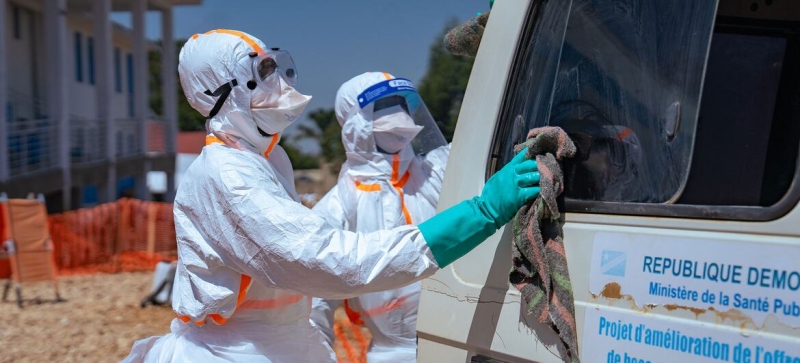

© WHO/J. Mulala Raymond Health workers disinfect vehicles during an Ebola outbreak in eastern Democratic Republic of Congo. WHO: Ebola outbreak in DR Congo has become the third largest in history Health Care
The Ebola outbreak in the Democratic Republic of Congo (DRC) continues to spread, outpacing efforts to contain it. In the two months since the epidemic was declared, 2,073 cases and 796 deaths have been registered, the World Health Organization (WHO) reported.
The current outbreak caused by the Bundibugyo virus is the third largest on record. The infection has spread faster over the past month than in any previous Ebola outbreak. By comparison, it took more than ten months for the number of confirmed cases to reach two thousand in the DRC in 2018-2019.
Unknown transmission chains
The most dire situation remains in the province of Ituri. More than 80 percent of new cases are detected among people not included in lists of known contacts. This indicates that many chains of transmission of the virus remain undetected.
WHO is particularly concerned that about two thirds of deaths occur outside of health care facilities: those who become ill do not have time to receive the necessary care.
Scaling up response
Together with the national Centers for Disease Control and Prevention and other partners, WHO is helping DRC authorities scale up their response to the outbreak.
The number of patient treatment beds has exceeded 800, and the number of laboratories has increased from one to 16. The proportion of contacts traced is close to 80 percent. In addition, more than 21 thousand community workers are being trained.
Drug and vaccine testing
There are no approved vaccines or treatments for Ebola caused by the Bundibugyo virus. However, several drugs are already undergoing clinical trials in the DRC. Thus, at the beginning of the month, specialists began testing the monoclonal antibody MBP134 and the antiviral drug remdesivir. The first safety study of the experimental vaccine ChAdOx1, led by the University of Oxford, has also begun. In addition, scientists are studying the possibility of using the antiviral drug obeldesivir to prevent the disease in people who have been in contact with infected people.
Despite the lack of an approved treatment, 377 patients have already recovered. The WHO emphasizes that early diagnosis and timely medical care significantly increase the chances of survival.
Conflict hinders the fight against the epidemic
Armed conflict complicates access to affected areas and prevents the expansion of response measures. The day before, a treatment center in the city of Bunia was attacked.
Strengthening epidemiological surveillance, safe disposal of dead bodies, improving the quality of treatment and interaction with local communities remain priorities in the fight against the Ebola outbreak. WHO is also strengthening the response in provinces where the virus has recently spread to prevent long-lasting chains of transmission there. However, more than $400 million is missing to implement the joint plan between WHO and the National Centers for Disease Control and Prevention.
“This is not charity, but an investment in national security,” the WHO emphasized, calling on international donors to urgently provide the necessary funding.