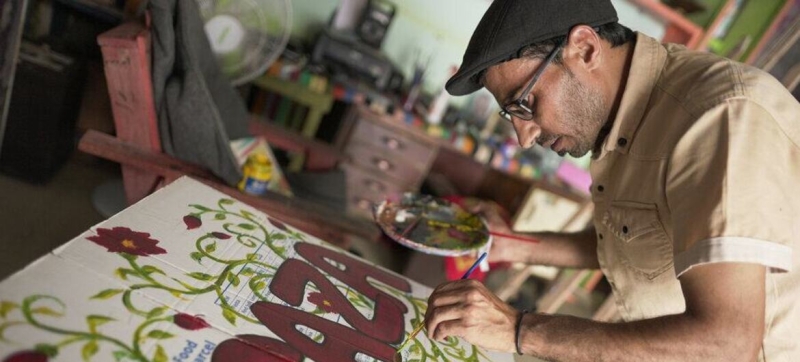

© WFP/J. Badwan Ahmed Muhanna draws on cardboard from WFP food boxes. Food boxes instead of canvases: an artist from Gaza talks about the war through art Culture and education
A boy looks at the viewer from a cardboard canvas. His face is distorted by a scream. In another painting, a little girl carries jugs of water, and nearby people clutch empty bowls in their hands. However, what attracts most attention is the image of a man whose head is bandaged, and whose face is blocked by graffiti in Arabic and English with the inscription Be human – “Be human.”
All these works were created by Palestinian artist Ahmed Muhanna. Instead of canvas, he used cardboard boxes from the World Food Program (WFP), the same ones that were used to deliver food to Gaza during the two-year war to help people survive.
Today, more than 60 of his works are presented at an exhibition organized by the WFP together with the European Union. Over the course of nine months, the exhibition traveled to 16 cities in nine European countries, from Brussels and Bonn to Barcelona and Marseille, attracting tens of thousands of visitors.
“Art is universal. It resonates with people,” says Caroline Van Nespen, an employee of the WFP Brussels office, who is supervising the exhibition. – That is why these works touch visitors so deeply. They help show the reality of life in Gaza.”
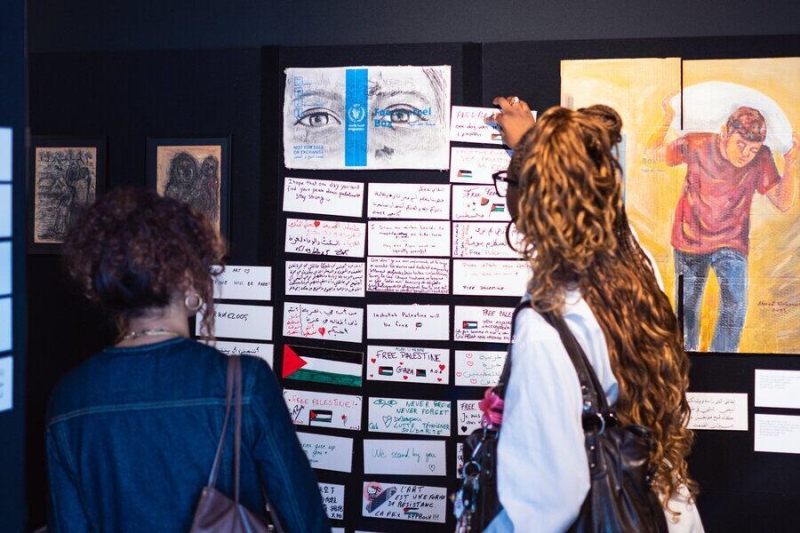
© VPP/A. Broomberg More than 60 works by the Gaza artist are on display at the exhibition, organized by the WFP together with the European Union.
Preserve the memory of the war through art
Like millions of residents of the Gaza Strip, Muhanna and his family were forced to flee their home after the outbreak of war in October 2023. He was so shocked by what was happening that he completely abandoned painting. However, a few months later, the artist began conducting art therapy classes for children who survived the war, and then took up his brush again.
“Art has ceased to be just creativity for me. It became a way to witness what was happening, preserve memory and express all the pain and hope,” says Muhanna.
Food as a symbol of hope
Due to closed borders, paint supplies gradually dried up. Then Muhanna began to draw with charcoal and leftover coffee. Instead of canvases, he used WFP food boxes, the contents of which still help almost 1.6 million Gazans today.
“These boxes were not just cardboard – they contained food that helped many families survive,” says the artist. “I wanted to show that food is not only a way to survive. It is also a symbol of hope.”
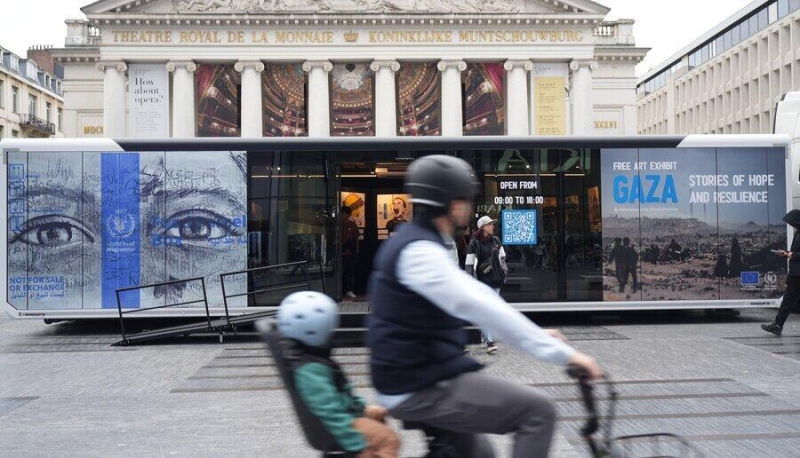
© VPP/A. Broomberg The exhibition opened in Brussels last September.
Dialogue through art
The exhibition opened in Brussels last September. It was presented in busy city squares in Europe: some visitors came there purposefully, having learned about it from the media or advertising, others came by chance – as the organizers had hoped. “The exhibition was conceived as street art – free and accessible.”
“Ahmed’s drawings touched me deeply,” noted the European Commissioner for Equality and Crisis Management, Hadja Labib, at the opening of the exhibition. – This is a very personal testimony of what remains of life in Gaza. They show all the hell that the sector is going through, but at the same time the incredible strength of the people who continue to live there.”
According to the organizers, the exhibition became not only an art project, but also a space for discussion. Visitors spend several hours here, watching a documentary about the artist and asking questions about the humanitarian situation in Gaza, the work of the WFP and how they can help. Muhanna himself was unable to leave the Gaza Strip and attend the exhibition in person.
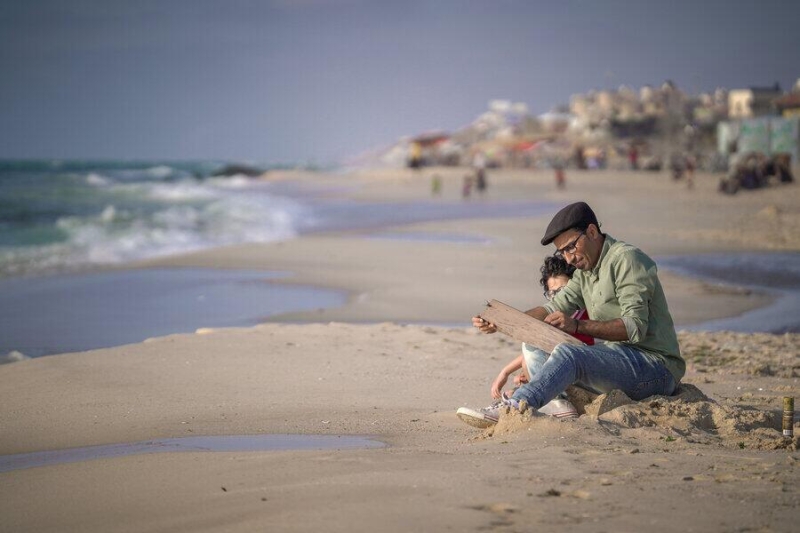
© WFP/J. Badwan The artist continues to paint and dreams of a future in which his children can live without fear.
The dream of a simple life
Eight months after the ceasefire, the humanitarian situation in Gaza remains extremely dire. Fresh vegetables and fruits are still in short supply, and most residents have lost their jobs and continue to live in tents or dilapidated buildings, trying to start life anew in the midst of ruins.
In addition to food packages, WFP provides people with monthly hot meals, bread and cash assistance, and also supports local entrepreneurs and communities, helping them gradually restore their sources of income.
The artist himself continues to paint and dreams of a future in which his children can live without fear.
“People here live one day at a time,” he says. – Many depend on humanitarian aid and what neighbors and relatives are willing to share. Solidarity has become one of the main ways of survival.”
During the war years, Mukhanna lost family and friends. But he continues to paint.
“I dream that my family can live a simple and dignified life: in a safe home, with food on the table, with a future in which survival is no longer the main concern,” he says. – Our dreams have become very modest. But to us they mean everything.”