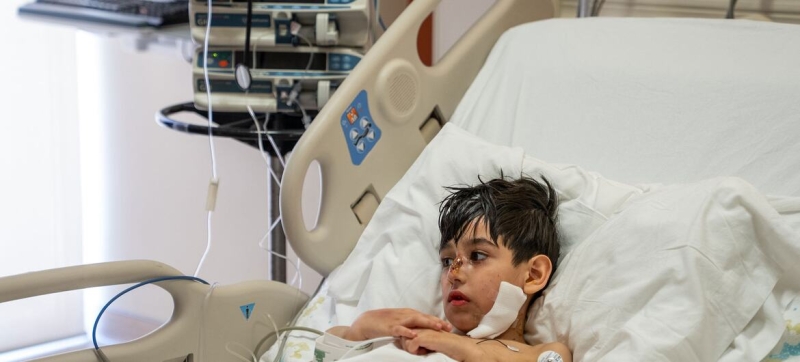

© UNICEF/F.Ciofani 5-year-old Ali was wounded during the attacks on Beirut in early April. His father pulled him out from under the rubble of a collapsed building. Lebanon: Despite truce between Hezbollah and Israel, 12 children are killed or maimed every day Peace and Security
Today, more than a hundred days after the conflict began to escalate, Lebanese civilians are still in dire straits. On Wednesday, the United Nations Children’s Fund (UNICEF) presented new data on the impact of Israeli strikes and mass displacement.
Unstable situation
Despite the recent agreement between the United States and Iran and signs of a decrease in tensions in the region, the humanitarian situation in Lebanon remains extremely difficult and unstable. This is according to the latest situation report from the United Nations Office for the Coordination of Humanitarian Affairs (OCHA).
247 children have been killed and another 992 injured since fighting between Israel and Hezbollah sharply escalated in southern Lebanon on March 2. On average, this means that 12 children are killed or seriously injured every day.
“For more than three months, children in Lebanon have been going through something that no child should have to go through,” UNICEF Lebanon Representative Marcoluigi Corsi said on Wednesday. As a reminder, on June 15, it was announced that the United States and Iran had reached agreement on a memorandum of understanding.
Talking to UN News Service, Corsi added: “We hope that the current ceasefire will actually turn out to be a real ceasefire, because since the previous ceasefire, violence against children and the conflict itself have virtually ceased.” have ceased.”
Ceasefire Violations
Although the intensity of fighting has decreased, UN peacekeepers in southern Lebanon continue to record an increase in military activity. This was announced by the press secretary of the UN Secretary-General, speaking on Wednesday at a briefing in New York.
According to the United Nations Interim Force in Lebanon (UNIFIL), there is a large movement of Israeli armored vehicles, continuous movement of supply convoys, major engineering works and destruction of facilities. From midnight to 4 p.m. Wednesday, 26 violations of Lebanese airspace by the Israeli military and one airstrike were recorded.
During the same period, the mission recorded 312 flights and launches: 291 were associated with the Israel Defense Forces, another 21 with Hezbollah. By comparison, Monday and Tuesday saw 174 and 189 such incidents, respectively.
60~p>“Outside the UN mission’s area of responsibility, we are aware of reports of Israeli artillery shelling and airstrikes in several areas, including Nabatiyeh, Saida and Jezzine, as well as repeated drone flights over Beirut and its southern suburbs,” the spokesperson said UN.
At least one vehicle hit in the Shuqing area reportedly killed four people and injured several others.
Maritime security
The UN mission also reported a violation of Lebanese maritime space: two Israeli warships were conducting patrols about 600 meters off the coast of Naqoura in the south of the country, where UNIFIL is based.
On Wednesday, the mission and its maritime component announced continued cooperation with the navy Lebanon to gradually transfer greater responsibility for the protection of the country’s territorial waters during 2026 – in accordance with the agreement signed last December. sea.”
Children’s position
A significant part of the country suffered serious damage. Residential buildings, schools, water and sanitation facilities, and other vital services were damaged. This has worsened an already dire humanitarian situation and left children with deep physical and psychological trauma.
Marcoluigi Corsi said one encounter at a UNICEF-supported hospital left an indelible mark on his memory. A teenage girl was injured as a result of the impact. The military called the consequences “collateral damage.” Her father and three brothers were killed in the attack. The mother survived, and the girl herself was in a coma for some time.
When she began to come to her senses, the first thing she asked was, “Where did humanity go?” “It’s very difficult to hear this question, which has no answer, from a 14-year-old child,” admitted Corsi. “No child should have to go through such a nightmare.”
A generation deprived of childhood
UNICEF estimates that more than 770,000 children are suffering from ongoing violence, loss and displacement. Many are unable to return home due to ongoing fighting and the threat of unexploded ordnance.
“Behind these terrible numbers are lives cut short, children damaged and families experiencing deep loss, trauma and uncertainty,” UNICEF said in a statement. Figures, the UN Children’s Fund emphasizes, are not capable of conveying the full scale of the tragedy: “In addition to the dead and wounded, an entire generation of children was deprived of a normal childhood. Their sense of security – something every child needs to grow and develop – has been deeply undermined.” days.
The agency is called upon to immediately protect children from further violence, ensure the safety of schools, hospitals, water systems and other civilian infrastructure, guarantee humanitarian access and respect international law.
“And most importantly, Lebanese children must be given a chance to do more than just survive this crisis, but to recover from it and regain the future that was jeopardized by the war,” the UN Children’s Fund is convinced.