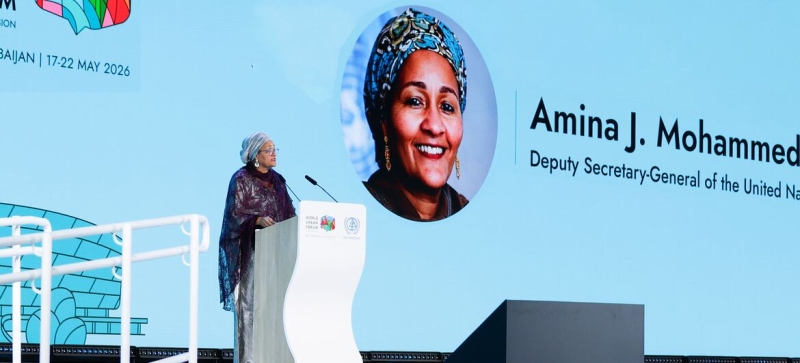

© UN-Habitat/Toghrul Deputy Secretary-General Amina Mohammed delivers closing remarks at the World Urban Forum. The “historic” session of the World Urban Forum ended in Baku Sustainable Development Goals
A historic gathering of more than 57,000 delegates – the largest ever at the World Urban Forum – ended on Friday in Baku with a call on the international community to rethink how it provides housing. Endorsed in Azerbaijan’s capital, the plan calls on governments, cities and communities to act together in the face of a crisis affecting billions of people around the world.
The Baku Call to Action, formulated by delegates representing 176 countries, proposes that housing should be seen as an integrated phenomenon linked to land, infrastructure, transport, services and economic opportunity. It also proposes addressing interrelated challenges such as rising housing costs, real estate speculation, and climate shocks through people-centered approaches.
The plan calls for addressing the inextricable link between housing and climate justice, expanding climate-resilient housing, and turning commitments into action through multi-level governance, financing, and support for local initiatives.
“There is no path to achieving the 2030 Agenda without sustainable urbanization and adequate housing,” said UN Deputy Secretary-General Amina Mohammed, speaking at the closing ceremony of the 13th session of the World Urban Forum. She stressed that the priority is now to create inclusive and sustainable cities that can provide safe housing and opportunity for all.

UN News Service A model of a “smart” city presented at the exhibition during the session.
The largest forum in history
The forum in Baku became the largest in history: more than 57 thousand delegates from 176 countries, over three thousand online participants, 11 heads of state, 88 ministers and 130 mayors. During the week, 579 events were held in the capital of Azerbaijan, and the Urban Expo exhibition attracted more than 74 thousand visitors.
According to Amina Mohammed, the housing crisis is at the intersection of almost every global issue – from poverty and inequality to climate, conflict and instability. She noted that adequate housing means access to clean water and sanitation, energy for cooking and heating, as well as affordability, security and security of tenure.
Mohammed noted that the forum is taking place at a difficult moment for international cooperation, when the values and principles of the UN Charter are being undermined, tensions and mistrust are rising. However, she said, cooperation remains the only way to cope with challenges of this scale.
A decisive moment for the future of housing policy
Executive Director of the United Nations Human Settlements Program (UN-Habitat) Anaclaudia Rossbach said the forum sent a “powerful signal” about the need for urgent action. She stressed that the world is at a defining moment for the future of housing policy and can no longer afford inaction. Housing systems are under great strain, she said, from inequality, speculation, weak governance, rapid urbanization, displacement and the climate crisis.
“Housing markets are clearly failing to keep up with demand: billions of people live in inadequate and unsafe conditions or cannot afford adequate housing,” she said she.
Amina Mohammed warned that the pace of change must accelerate. “The next decade of the New Urban Agenda cannot be the same as the previous one. We need more ambition. More funding… More political determination,” she emphasized.