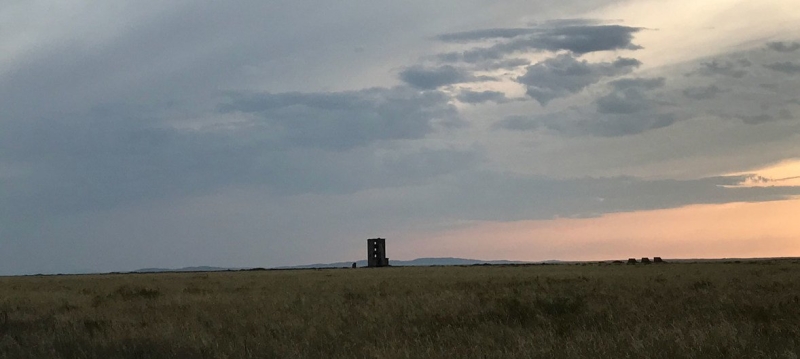

UN News Service/N. Sheki During the period until 1989, at least 468 nuclear tests were carried out at the Semipalatinsk test site. Central Asia without nuclear weapons: 20 years of the Semipalatinsk Treaty Peace and Security
In the year of the 20th anniversary of the Semipalatinsk Treaty, against the background of the growing nuclear threat and geopolitical tensions, the experience of Central Asia is of particular importance. Twenty years ago, the region where the Soviet Union had conducted nuclear tests for decades opted for security by creating a Nuclear Weapon Free Zone.
On the sidelines of the Review Conference of the Parties to the Treaty on the Non-Proliferation of Nuclear Weapons, which is taking place these days at the UN headquarters, a special round table organized by Kazakhstan was dedicated to the 20th anniversary of the creation of the Nuclear Weapon Free Zone in Central Asia. Its participants discussed how this agreement helps strengthen international security in an increasingly unstable global environment.
It is symbolic that the agreement itself was signed in 2006 in Semipalatinsk – the site of one of the world’s largest nuclear test sites. For forty years – starting in 1949 – on a territory with a total area of 18.5 thousand square kilometers, the Soviet Union carried out 456 explosions. The test site was closed by decree of the President of Kazakhstan in 1991, but the consequences of the tests still affect human health and the environment.
The agreement, known as the Treaty of Semipalatinsk, brought together Kazakhstan, Kyrgyzstan, Tajikistan, Turkmenistan and Uzbekistan. It came into force in 2009 and formalized the voluntary renunciation of these states from the development, acquisition, testing and deployment of nuclear weapons. Monitoring compliance with obligations is carried out by the International Atomic Energy Agency (IAEA).
Speaking at the round table, the head of the weapons of mass destruction division of the UN Office for Disarmament Affairs, Christopher King, emphasized that nuclear-free zones remain an important instrument of global security. “Nuclear weapon-free zones are not only a historic achievement, but also a valid tool for regional security, non-proliferation and nuclear risk reduction,” he noted.
He also emphasized that the Central Asian zone has become an example of effective regional cooperation, uniting five countries within the framework of a legally binding agreement.
“Such zones promote transparency, build trust, and reduce risk, and serve as a bridge between regional security and global nonproliferation efforts,” King added. UN News Service/K. Konyrova Painting by international anti-nuclear movement activist Karipbek Kuyukov. First Deputy Minister of Foreign Affairs of Kazakhstan Yerzhan Ashikbayev, who heads the country’s delegation to the Review Conference, is convinced that the significance of this agreement goes far beyond the region. “The contribution of the Semipalatinsk Treaty to ensuring security not only in Central Asia, but also beyond it is unconditional,” he noted in an interview with the UN News Service. According to the diplomat, the creation of the zone was the result of a common desire of the countries of the region to strengthen peace, stability and security, as well as overcome the difficult legacy of nuclear testing. However, as Ashikbaev emphasized, practice shows the opposite. “On the contrary, it is precisely during such critical periods that the zone proves that its existence is a positive factor,” he said. Kazakhstan, he said, remains committed to multilateral diplomacy, and the development of the zone is part of this policy. The experience of Central Asia is of interest in other regions of the world. However, as Ashikbayev noted, the creation of such zones should be a sovereign decision of the states themselves. “The creation of such zones cannot be imposed from the outside. This should be a sovereign decision of the states,” he emphasized. At the same time, the consequences of the nuclear past continue to be felt today – primarily in the area of the former Semipalatinsk test site. “The consequences of nuclear tests are long-term consequences, for a century to come,” the diplomat noted. According to him, rehabilitation programs are being implemented in the region, a modern oncology center has been created, and some previously closed areas are gradually returning to economic use after a thorough inspection. At the same time, security measures are being strengthened in other areas. Despite the progress made, work to overcome the consequences of the tests remains a key challenge. The Semipalatinsk Treaty has unique features: it is the only nuclear-weapon-free zone located entirely in the northern hemisphere and bordered by two nuclear-weapon states. It is also the only Zone where in the past they not only tested a nuclear bomb, but also deployed atomic weapons. Experts note that in conditions of global instability, the importance of such agreements only increases.