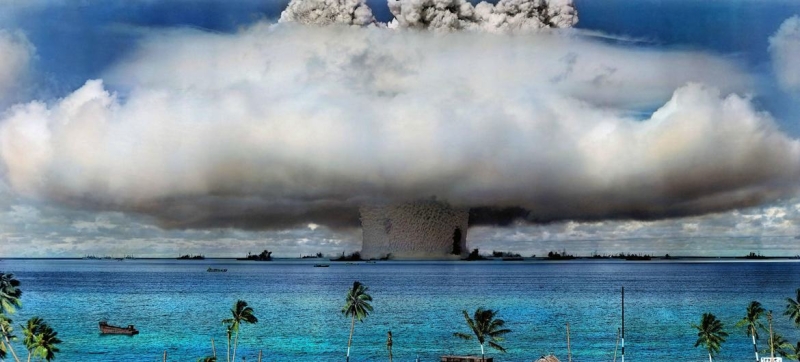

© US Government Nuclear weapons test at Bikini Atoll (Marshall Islands) in 1946. The UN is discussing the future of the Treaty on the Non-Proliferation of Nuclear Weapons Peace and Security
Against a backdrop of growing nuclear risks and deepening global mistrust, representatives from around the world are gathering at UN headquarters to answer a key question: whether the main international mechanism to curb the spread of nuclear weapons can survive. The 11th Review Conference of the Treaty on the Non-Proliferation of Nuclear Weapons (NPT) kicks off in New York.
This treaty, which entered into force in 1970, is considered one of the most important achievements in the history of the UN. It aims to prevent the proliferation of nuclear weapons, promote nuclear disarmament and develop the peaceful uses of atomic energy. The document has been ratified by 191 states and remains the cornerstone of international security.
A new era of instability
Today, the nuclear arms control system is facing one of its most serious crises in decades. Many Cold War agreements have either lapsed or are no longer valid. In particular, the START III treaty between the United States and Russia, which limited strategic nuclear weapons, expired in February. documents.
The current conference, taking place from April 27 to May 22, is to assess the implementation of the treaty and determine whether it is capable of ensuring progress in the field of disarmament and international cooperation.
“Collective amnesia”
Speaking at the opening of the conference on Monday, UN Secretary-General António Guterres warned of the return of the nuclear threat and the weakening of arms control.
“This conference provides a timely opportunity to unite and to protect humanity from the serious threat of nuclear destruction,” – he said.
Guterres recalled that after World War II, the world was already living in constant fear of a nuclear disaster.
“Humanity lived in the shadow of a possible nuclear Armageddon,” he noted, adding that the world today faces “collective amnesia” regarding these threats.
According to him, the situation is only deteriorating. The UN chief pointed to rising military spending, which reached $2.7 trillion last year, 13 times more than global spending on development assistance. For the first time in decades, the number of nuclear warheads is increasing, and some states are openly considering the possibility of acquiring them. under threat
Guterres stressed that the NPT remains the basis of international efforts to prevent a nuclear disaster, but its effectiveness is weakening.
“Commitments are not being fulfilled. Trust and authority have been undermined,” he noted. wars.
New threats
The UN head paid special attention to new risks associated with the development of technologies, including artificial intelligence and quantum computing.
According to him, the treaty should adapt to new realities and take into account the connection between nuclear weapons and modern technology.
The Secretary-General called on world leaders to abandon inaction: “Let’s overcome this collective amnesia. Let’s restore faith in what we can achieve together. Let us act without delay to end the threat looming over humanity.”