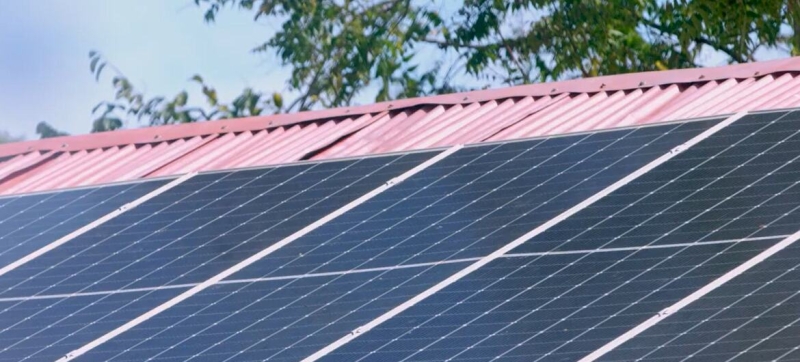

Solar panels in Kenya. UN Secretary General calls on countries to participate in a “renewable energy revolution” Climate and Environment
UN Secretary-General António Guterres reiterated his call on governments to accelerate the transition from fossil fuels to clean energy, recalling that war and climate change pose unprecedented challenges for humanity.
“The conflict in the Middle East has triggered the worst energy crisis in a generation,” he said in a video message to participants at the Petersberg Climate Dialogue, which opened in Berlin on Tuesday.
“And this proves one fact: fossil fuels are not only destroying our planet – they are holding the economy hostage,” added the UN chief. renewable energy: last year they reached $2.2 trillion – twice as much as fossil fuel investment. Guterres said there is a need to act on three fronts.“First, we must respond to the energy crisis without exacerbating the climate crisis,” he said, recalling that the world just experienced its 11 hottest years on record and that “every key climate indicator is at critical juncture.” systems.
Finally, the international community must mobilize funding, especially for developing countries, since “without support, the transition will be slower, less equitable and less secure.”
Implement commitments obligations
He noted that for developing countries, the cost of financing clean energy is two to three times higher than for developed economies. “However, many developed countries are moving away from their climate and development finance commitments,” he added.
The UN chief called for climate justice, urging countries to replenish multilateral climate funds and mobilize $1.3 billion annually by 2035 to support developing countries. increasing funding for adaptation “as a matter of survival.”
While communities on the front lines of the climate crisis have contributed the least to its creation, they are the ones bearing the greatest losses.
“Adaptation saves lives, protects livelihoods and strengthens economies,” he said. “And every dollar invested today reduces future losses many times over.”
Addressing the international community, the Secretary-General warned: “We can repeat the mistakes of the past, or we can launch a renewable energy revolution.”
He called on leaders to “make the right choices” for climate stability, energy security and a livable future.
60~h2>Climate negotiations
The Petersberg Climate Dialogue is an international conference held annually by Germany to advance negotiations in the lead-up to UN climate conferences. The two-day meeting brings together ministers and senior representatives from around 40 countries.
According to the secretariat of the United Nations Framework Convention on Climate Change (UNFCCC), discussions are focused on three key priorities: implementation of the Paris Agreement, international climate finance and geopolitical sustainability.
Next UN climate conference – COP 31 – will be held this November in Antalya, Turkey.
The UN Framework Convention Secretariat supports the Petersberg Dialogue as part of the broader multilateral climate process.
It is noted that informal dialogue “allows parties to seek solutions to complex issues outside the formal framework negotiations.”
In addition, “such exchanges help identify common ground ahead of the intersessional climate talks in Bonn in June and contribute to the preparation of decisions for COP 31.”