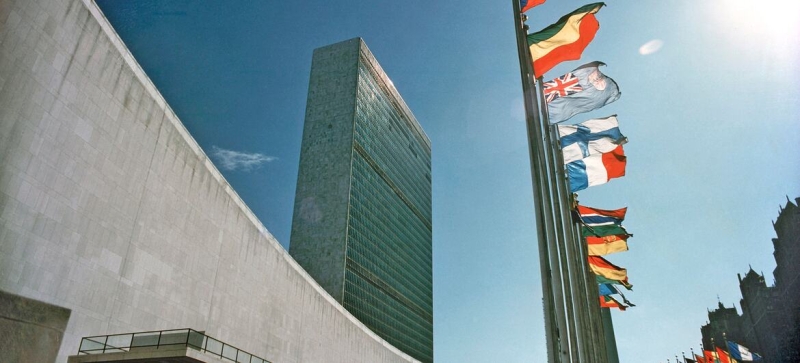

UN headquarters building in New York. UN unveils major reform of humanitarian system UN
The UN General Assembly was briefed on Friday on the latest achievements of the UN 80 initiative aimed at improving the Organization’s effectiveness and preparedness for future challenges. In particular, they discussed progress in developing the New Humanitarian Compact, as well as reforms in the field of training and research.
Since the launch of the initiative in March 2025, teams led by Secretary-General António Guterres have been working on a broad package of proposals covering peacekeeping, development, human rights and humanitarian work, as well as the overall areas of data, technology and services. defining the activities of the UN), as well as finding ways to strengthen the coherence and collective work of the entire system.
The briefing on February 27 was devoted to proposals for streamlining humanitarian operations and the possible unification of several UN structures involved in training and research.
Under-Secretary-General for Policy Guy Ryder began the meeting with an overview of UN80’s progress over the past 12 months, noting that the scale and complexity of the reforms made them difficult to grasp. He promised to provide clearer information and a fuller vision of the process in a forthcoming report.
Eliminating duplication of humanitarian efforts
Under-Secretary-General for Humanitarian Affairs and UN Emergency Relief Coordinator Tom Fletcher introduced the “New Humanitarian Compact,” a process to reform humanitarian operations that are under unprecedented pressure pressure.
He was joined by the heads of key UN humanitarian agencies – UNICEF Executive Director Catherine Russell, International Organization for Migration (IOM) Director-General Amy Pope, UN High Commissioner for Refugees Barham Saleh and World Food Program Assistant Executive Director Matthew Hollingworth. They all spoke of how their organizations are strengthening collaboration and “working as one.”
Catherine Russell noted that a system in which aid agencies operate in parallel—with their own warehouses, transport, contracts and logistics networks—is no longer sustainable.
“When supply chains are integrated, children get help faster. When food distribution systems are harmonized, fewer children suffer from malnutrition. When diplomatic efforts are coordinated, humanitarian access improves,” she noted.
Fletcher, praising the efforts of the five agencies to coordinate the work, noted that in an environment where needs are growing faster than the volume of available resources, the coordinated work is already producing tangible results on the ground.
“Reform is absolutely necessary,” he said. “The reset means clearer priorities for saving lives, radically improving the effectiveness of our work, and defending our values and principles, which are under constant pressure.” functions, high costs and financial risks.
United Nations University Chancellor Professor Tshilidzi Marwala and United Nations Institute for Training and Research (UNITAR) Executive Director Michelle Giles-McDonough have proposed reforms that would merge separate entities and create a coordination mechanism to make better use of resources.
60~p>Marwala also introduced the idea of an artificial intelligence-based platform to counter disinformation and strengthen the link between research and training.
“In an organization as complex as the UN, expertise and operational experience are often dispersed across different structures,” he noted. “Such a platform could connect the practical experiences and needs of Member States with scientific priorities, translating research results into applied educational tools.”
Next steps towards the Organization’s “relevant objectives”
An update on the UN 80 initiative is planned to be presented to civil society at the end of March. Also in July, there will be a high-level event organized as part of the High-Level Political Forum.
The Secretary-General intends to demonstrate to heads of state and government in September, during the High-Level Week of the General Assembly, that the UN system can effectively deliver on its responsibilities and evolve.
What is at stake, according to Guy Ryder, is “the ability of the UN system to rise to the occasion.” and fulfill our obligations” in accordance with “the challenges of today and in the face of tomorrow’s uncertainty.”