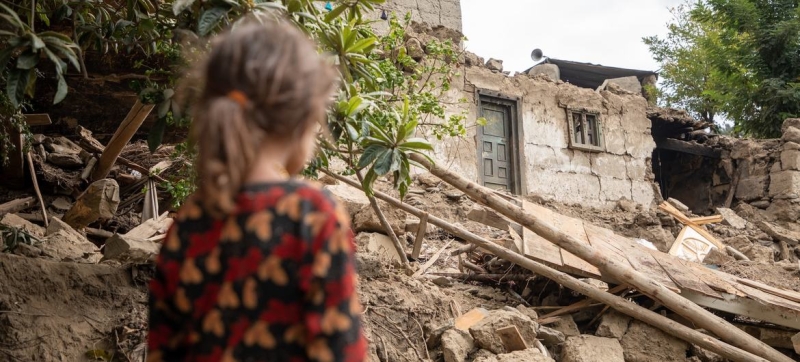

An Afghan girl looks at the ruins of her home, destroyed by an earthquake. UN Security Council informed of the catastrophic humanitarian situation in Afghanistan Humanitarian aid
At a UN Security Council meeting on Wednesday, Under-Secretary-General for Humanitarian Affairs Tom Fletcher said Afghanistan is facing one of the worst humanitarian disasters of modern times.
Nearly 22 million Afghans will require assistance in 2026, making the country the third worst humanitarian crisis in the world after Sudan and Yemen.
Famine and natural disasters
The UN is asking for $1.7 billion to help Afghanistan’s 17.5 million people, of which $375.9 million is urgently needed to help the 3.9 million most vulnerable Afghans. The number of people suffering from hunger in Afghanistan has risen for the first time in four years, reaching 17.4 million. More than 2.6 million refugees returned to the country in 2025, and more than four million in just the last two years. Most are women and children, who face severe restrictions on education, work, and access to health care.
The country was further hit by two major earthquakes in August and November, killing thousands and destroying entire villages. Drought has affected 3.4 million people this year, reducing crop yields and accelerating water depletion.
Restrictions on women’s work
Tom Fletcher stressed that restrictions on women working in humanitarian organizations seriously complicate the provision of external assistance. In September, the country’s de facto authorities banned UN staff from visiting offices and, in October, from working at key reception centers for returning refugees. In addition, humanitarian operations face bureaucratic obstacles and pressure from local authorities.
Lack of external funding
Lack of funding has already led to dire consequences. For the first time in years, as the cold weather set in, there was almost no international food supply, with only about a million people receiving aid, down from the 5.6 million the year before. 305 feeding stations have closed, leaving 1.1 million children without vital support. Also, 422 health care facilities were closed, leaving three million people without access to health services.
Tom Fletcher concluded his remarks by making three key requests to Security Council members: support the humanitarian exception in Resolution 2615, insist on lifting restrictions on women aid workers, and fund a global humanitarian plan to avoid further cuts to aid to the people of Afghanistan.
Human Rights and Freedom Media
The acting head of the UN Assistance Mission in Afghanistan (UNAMA), Georgette Gagnon, said the situation in the country “requires urgent attention and broader international support.” The Security Council meeting coincided with International Human Rights Day on December 10, which Gagnon said “recalls the enduring relevance of the Universal Declaration of Human Rights and its promise to uphold dignity, equality and justice for all.”
She emphasized that women and girls continue to be systematically excluded from almost all areas of public life. The ban on secondary and higher education for girls is now in its fourth year, “depriving Afghanistan of future doctors, entrepreneurs, teachers and leaders.” Media freedom is also declining, with journalists facing intimidation, detention and censorship, she said.
Security situation
Gagnon noted that the security situation from the outside appears relatively calm, but tensions between Afghanistan and Pakistan are rising, leading to closures border crossings and economic losses. She welcomed Pakistan’s decision to allow the transit of humanitarian supplies to Afghanistan and called on the parties to respect the ceasefire. telecommunications, including the Internet, people lost access to medical care, banking services and humanitarian support. This decision was so devastating that it had to be reversed.”
Gagnon said the incident “clearly demonstrates the division within the de facto authorities – between those who support isolation and those who understand the need to maintain ties with the outside world.”