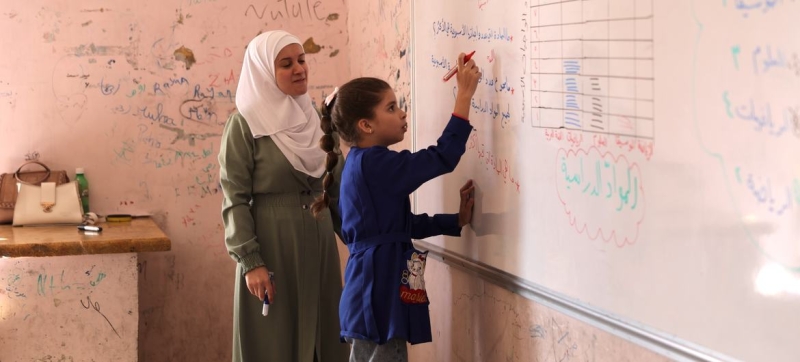

A school in Aleppo province that suffered significant damage during the conflict and was repaired with the support of UNICEF. Syria’s transition: significant progress and remaining risks Peace and Security
A year into the transition period in Syria, the UN Security Council discussed progress made and ongoing threats. Under-Secretary-General for Political Affairs Rosemary DiCarlo noted that Security Council members, during a visit to Syria on December 4, “saw first-hand both the opportunities the country faces and the challenges it faces.”
She said Syrians, commemorating the events that culminated in the political transition on December 8, 2024 in early December, “reaffirmed their continued belief in peace, stability, prosperity and justice for their country – despite the obvious and serious challenges facing them.”
Among the positive steps DiCarlo pointed to the restoration of state institutions, the beginning of the integration of armed forces under a single command, the adoption of a constitutional declaration, the formation of a new cabinet of ministers and the holding of indirect legislative elections in October. The National Dialogue Day was also held, and the People’s Council and the Constitutional Court may be fully formed in the near future.
In addition, a number of countries have lifted bilateral sanctions against Syria. DiCarlo recalled that “just yesterday the US Congress repealed the Caesar Act, and last month the Security Council adopted Resolution 2799, which removed the sanctions designations from President Sharaa and Interior Minister Khattab.”
Unstable situation
Despite the decrease in violence, the situation remains unstable. “The situation on the ground remains fragile and intercommunal dynamics are tense,” the UN spokeswoman said. “Unfortunately, over the past year, these tensions have boiled over into violence,” she noted, pointing to large-scale clashes in coastal areas in March, a terrorist attack on a church in Damascus in June and violence in the predominantly Druze province of Suwayda in July.
DiCarlo stressed that the United Nations “unequivocally condemns the violence” and called for transparency in investigations and bringing those responsible to justice.
Regional security issues
Israel strikes in the south of the country are of particular concern. According to the speaker, at the end of November, “as a result of the invasion and accompanying IDF strikes on the city of Beit Jinn, 13 people were killed,” and local residents were forced to leave their homes.
She reiterated the Secretary-General’s call for Israel to “refrain from violating the sovereignty and territorial integrity of Syria” and stressed the need to respect the 1974 Separation of Forces Agreement. “Resumption of dialogue between Syria and Israel on security issues is urgently needed,” she said.
Terrorist Threats
DiCarlo also pointed to the continued focus on counterterrorism, as well as concerns about the presence of foreign fighters and the possible resurgence of ISIS. She recalled the recent attack on a joint US-Syrian patrol in the Palmyra area, which resulted in the deaths of two American soldiers and one civilian interpreter. Syrians.”
This underlines the need, DiCarlo said, for the political transition to be accompanied by “a Syrian security sector reform program, as well as disarmament, demobilization and reintegration measures.”
Humanitarian situation
Assistant Secretary-General Joyce Msuya delivered a humanitarian briefing on behalf of the UN Emergency Relief Coordinator. She noted that “the hope that began a year ago” remains encouraging, but stressed the need for “vigorous and sustained international support.”
One of the most visible signs of Syrians’ faith in the future, she said, was people returning home. “Two million internally displaced people have returned, many after years of living in camps,” she said, adding that “more than 1.3 million have returned from neighboring countries.”
But many are returning “to damaged or destroyed homes and communities with very limited access to basic services and jobs,” so they will continue to need humanitarian assistance.
UN humanitarian agencies have been able to simplify and streamline operations and are now providing assistance to 3.4 million people every month— “up 25 percent from last year, despite lower levels financing.”
“Rarely has a crisis of such magnitude as the one in Syria opened up such significant opportunities to turn the situation around. The past year has given us cause for hope and encouraged us to redouble our efforts. We must take advantage of this moment,” Msuya emphasized.