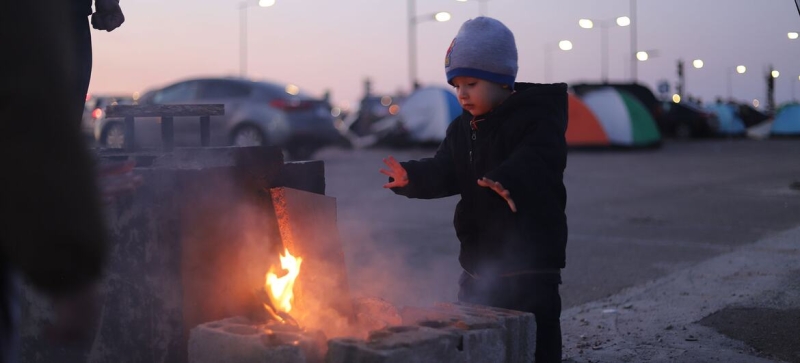

Internally displaced people in Lebanon spend the night in tents on the street. Middle East: more and more people need humanitarian assistance Peace and Security
Heavy airstrikes that have continued since February 28 have resulted in numerous civilian casualties in Iran and widespread destruction in at least 20 provinces, including Tehran, Esfahan and Kermanshah, the UN Office for the Coordination of Humanitarian Affairs (OCHA) said.
Since the beginning of the war, more than 1.2 thousand people have been killed, over 17 thousand have been injured.
Millions of people have fled the affected areas. It is estimated that up to 3.2 million people are internally displaced.
Houses, schools, medical facilities and cultural heritage sites were hit. Humanitarian organizations warn that the need for shelter and humanitarian aid is growing rapidly as the crisis deepens.
125 thousand people fled Lebanon for Syria
Meanwhile, according to the International Organization for Migration (IOM), more than 125 thousand people fled from Lebanon to Syria. The majority are Syrian citizens, as well as about 7,000 Lebanese.
The organization also notes that half of all refugees are children.
IOM warned that many families are arriving with little or no resources and called on the international community to urgently help people arriving in Syria.
Major destinations are already under severe pressure, and a further influx of refugees could pose a serious challenge to host communities.
Rising tensions in the Persian Gulf
Two new incidents involving ships in waters off the coast were reported today Qatar and the United Arab Emirates.
At the same time, gas prices rose sharply on Thursday after an attack allegedly carried out by Iran on Ras Laffan, Qatar’s largest energy complex. This was in response to an Israeli strike on the South Pars gas field in Tehran the previous day.
In one case, a ship east of the Ras Laffan was hit, but the crew were reportedly unharmed. In another, a ship east of the town of Khor Fakkan caught fire after being hit by a shell, the UK Maritime Trade Authority said.
A total of 22 incidents have been recorded in the region since the escalation began on February 28, of which 16 are classified as attacks. Vessel crews are advised to exercise increased caution.
The UN Maritime Agency has resumed an emergency session
The Council of the International Maritime Organization (IMO) resumed an extraordinary session focusing on the risks to shipping and seafarers in the Persian Gulf and Strait of Hormuz.
Opening the meeting on Wednesday, IMO Secretary-General Arsenio Domínguez expressed serious concern about attacks on merchant ships that have killed and injured seafarers, and warned that some 20,000 members crews remain at risk.
He stressed that “any attack on peaceful seafarers or civilian vessels is completely unacceptable” and called for de-escalation and safe passage for crews.
Delegates are expected to continue discussing practical measures to ensure maritime safety, seafarer protection and maritime Wednesday.
Rafah crossing reopened for medical evacuation
In Gaza, the Rafah crossing reopened for medical evacuation of patients leaving the enclave for treatment. True, the number of those allowed to enter and leave is limited.
OCHA notes that the scale of evacuation should be much wider.
“As we said earlier, the opening of crossings should be meaningful,” said Office representative Olga Cherevko, calling for both the movement of people and the delivery of humanitarian and commercial supplies. cargo.
She warned that the situation in Gaza remains dire, with tight restrictions making it difficult to provide assistance to the population.