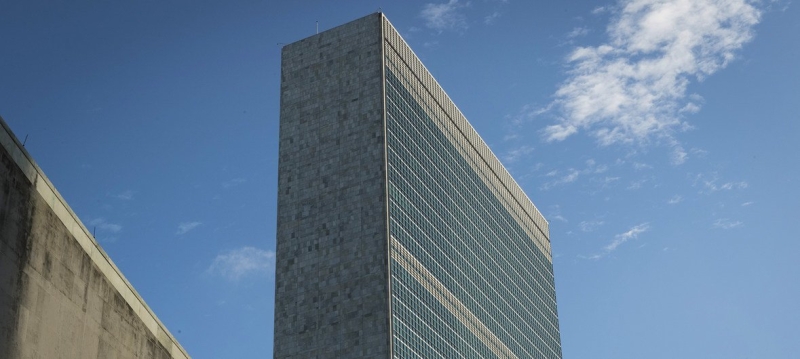

UN Secretariat building in New York. Member countries’ debt to the UN approaches $1.6 billion UN
The UN Secretary-General warned Monday that chronic delays in nearly $1.6 billion in contributions from member states to the Organization’s budget are undermining the UN’s ability to function effectively – even with deep cuts already included in next year’s budget plan.
Speaking at a meeting of the Fifth Committee of the General Assembly, which deals with the budget of the United Nations, António Guterres said that the UN faces the most fragile financial situation in recent years.
“Liquidity remains fragile and this problem will continue regardless of the size of the final budget,” the UN chief stressed, pointing to “unsustainable levels of debt.” Member States.
Unpaid Dues
The UN ended 2024 with $760 million in outstanding dues, most of which remains outstanding, and has not yet received $877 million in dues due for 2025. This brings the total debt to about $1.586 billion.
Less than five weeks before the end of this year, only 145 of the 193 UN member states have paid their 2025 dues in full. A number of key payers, including the US, have yet to make their payments, while China paid the full amount on October 29. Russia is also among those who have not yet paid their dues. “I have repeatedly called on Member States to pay their dues in full and on time,” the Secretary-General said.
Cuts are already in the budget
The UN chief’s warning comes as the UN chief’s warning comes amid discussions on revised estimates of the UN regular budget for 2026, which already reflect deep structural cuts as part of the UN 80 reform – initiative aimed at increasing efficiency and reducing costs.
Under the revised proposal, the UN regular budget for 2026 would be $3.238 billion, down $577 million (15.1 percent) from 2025. The plan is to cut 2,681 positions, representing 18.8 percent of current levels.
Special Political Missions will also face cuts of more than 21 percent from 2025 levels, primarily due to mission closures and personnel streamlining.
Consolidation of functions and relocation of workers seats
To save money, the UN plans to consolidate payroll processing into a single global system and create shared administrative centers in New York and Bangkok.
The Secretariat is also considering a list of functions that could be moved to lower-cost regions. Since 2017, ending leases in New York has already saved the UN $126 million, with an additional $24.5 million expected per year by 2028.The revised estimates have been reviewed by the Advisory Committee on Administrative and Budgetary Affairs and are being discussed by the Fifth Committee ahead of final budget approval before the end of the year.
Advisory Committee Chair Juliana Gaspar-Ruas noted that the committee welcomes the reform, but cautioned that the revised estimates were prepared in a short time frame, which has limited the ability to closely evaluate the validity of some cuts.
Member states supported the Secretary-General’s efforts to present revised estimates, acknowledged liquidity concerns and expressed support for a stronger and more flexible UN. However, a number of delegations expressed concern about tight deadlines and late submissions of key documents, making thorough vetting difficult.
Some diplomats warned that the proposed cuts would hit junior and support staff more heavily than senior positions, threatening geographic balance and staff turnover.
Others noted that the cuts look unevenly distributed among the UN’s main areas of work, with larger cuts coming to development programs.
The Secretary-General acknowledged these concerns, assuring: “Our development commitments are absolutely fundamental, as are our commitments to the African continent.”
The UN budget must be finally approved by the end of this year by the General Assembly Assembly.