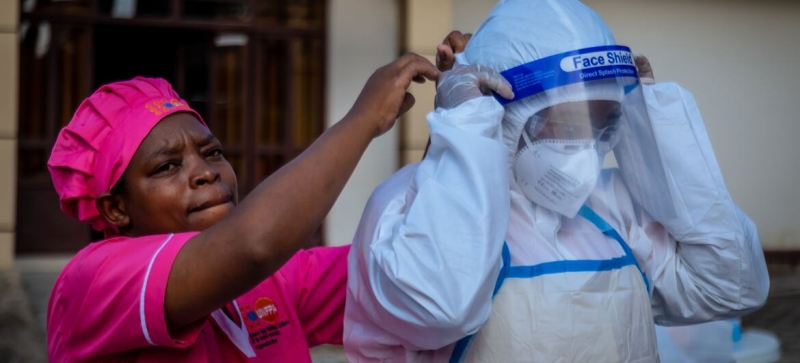

©UNFPA/J. Yunus The current Ebola outbreak in the DRC is the third largest in modern history. The Ebola outbreak in DR Congo is spreading faster than at any time in modern history. Dominika Tomaszewska-Mortimer Healthcare
The spread of the Bundibugyo variant of the Ebola virus in the Democratic Republic of Congo (DRC) has reached record levels, with the majority of new cases coming from “unknown chains of transmission.” The World Health Organization (WHO) warned about this on Tuesday.
Speaking to reporters in Geneva after returning from Ituri province in eastern DRC, where the epicenter of the outbreak is located, WHO Emergencies Program Executive Director Chikwe Ihekweazu said that as of July 11, there were almost 2,000 confirmed cases and more than 700 deaths in five provinces. That makes the current outbreak the third largest in modern history. “We are seeing the fastest spread within a month of the outbreak and of any Ebola outbreak we have dealt with,” he said. “Over the past few days, we have recorded the highest number of new infections in a single day.” Dr. Ihekweazu added that more than 80 new cases of infection were confirmed in just 24 hours.
Much remains unknown
Many of the newly reported deaths are people who died at home without ever reaching a health facility or receiving care, which a WHO official called “very worrying.” Despite advances in diagnostics and high levels of tracing, 80 percent of new cases are not listed as contacts and come from unknown chains of transmission, Ihekweazu warned. The current outbreak was identified almost two months ago, and WHO modeling suggests its true extent may be “at least two to four times” the number of reported cases. “Imagine it’s a fire,” Dr. Ihekweazu said. “At the center of it there is a source that feeds the fire, and that fire is spreading further and further.” While up to 95 percent of new cases are in Ituri, where the outbreak began, the virus has recently spread to two more provinces. cases.” “Now is not the time to lose the initiative,” he warned.
Clinical trials continue
Several therapeutic drugs are currently in clinical trials, but there is no approved treatment for patients with the Bundibugyo variety. However, the chances of survival increase significantly with early treatment. “We must identify cases of infection as early as possible and get people to health facilities as quickly as possible,” said Dr. Ihekweazu.
Attacks on health facilities
Responding to questions about recent attacks on health workers and health facilities, he noted that the solution to the problem lies in “openness and transparency” about the care provided. “Before any new center opens, we invite local community leaders to see what is happening there and to talk to health workers who have left their homes to help respond to the outbreak,” a WHO official said.
“We need the world to come together.”
Dr. Ihekweazu noted the disparity between the scale of the threat and the efforts currently underway internationally. “The world needs to come together – not just for charity or to support the DRC, but also in our own interests. The more we do now, the better protected we will be in the future,” he stressed. A WHO representative said that at the organization’s headquarters in Geneva, member states are negotiating a key part of the Pandemic Agreement – the access to pathogens and benefit-sharing annex, which should ensure the rapid dissemination of genetic information on dangerous pathogens with pandemic potential, as well as the availability of vaccines and other treatments to developing countries.