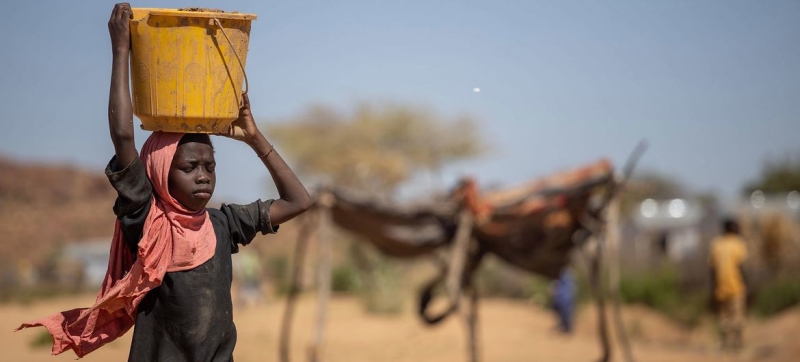

© UNFPA/K. Prinsloo A girl carries water in a camp for Sudanese refugees in Chad. UN Security Council: terrorism threats and cooperation in West Africa and the Sahel Peace and Security
Terrorist groups continue to pose a serious threat in West Africa and the Sahel. This was stated at a meeting of the UN Security Council by the Special Representative of the Secretary General for the region, Leonardo Santos Simão.
On positive news, he reported that in a number of states there were signs of restoration of political dialogue and regional cooperation.
Terrorist groups are changing tactics
According to the head of the United Nations Office for West Africa and the Sahel (UNOWAS), armed extremist groups continue to pose a threat to the population, especially in the central Sahel and northern Nigeria, while increasing activity in the coastal countries of the Gulf of Guinea.
“These groups are adapting their tactics, increasingly using modern technologies, including drones, new communications and cryptocurrencies,” Simão said. He noted that attacks are increasingly being coordinated on multiple fronts and have a cross-border nature.
The UNOWAS chief also warned of the rapid spread of drug trafficking and consumption, especially in coastal states. Young people are the primary victims of the trend, he said, and there are reports that terrorist groups are also using drugs.
At the same time, humanitarian organizations face severe restrictions on access to those in need, and lack of funding is reducing the scope of life-saving assistance. Women, children and youth are experiencing the most severe consequences of the crisis.
The region returns to dialogue
Despite the ongoing threats, Simão noted that diplomatic contacts are being strengthened in the region and steps are being taken to restore cooperation.
According to him, concrete results have emerged in recent months. The Kamba border crossing between Niger and Nigeria reopened in February, restoring an important trade route. Contacts between Benin and the countries of the Alliance of Sahel States are resuming, and negotiations on opening the border between Niger and Benin continue. representation.
“These are examples of regional efforts aimed at establishing dialogue and leading to cooperation between countries in the region,” he emphasized.
Democratic processes continue
The Special Representative of the Secretary General noted that, despite numerous challenges, democratic processes in the region continue to develop.
During the reporting period, elections were held peacefully in Benin, Cape Verde, Cote d’Ivoire and Guinea. Reforms to strengthen institutional accountability and the rule of law are continuing in a number of countries.
However, some countries, particularly in the central Sahel, are introducing new restrictions on political activity and the work of public organizations. According to Simão, the authorities explain these measures by the need to strengthen the state in the context of a transition period and a difficult security situation. However, political parties and civil society organizations are expressing growing concern.
Simau stressed that the timing of the return to constitutional rule in the three countries of the central Sahel remains uncertain.
Military measures alone are not enough
The fight against terrorism cannot be limited solely to military action, UNOWAS chief says methods.
“Addressing the root causes of instability requires investment in the social, economic and environmental foundations of the world,” he said.
Simão spoke about the work of the UN Office to promote cooperation in water resources management, as well as to strengthen maritime security and combat drug trafficking. He cited the example of northern Togo, where a combination of security measures with development programs and humanitarian support is already helping to improve the situation.
Despite ongoing economic difficulties, including inflation, rising public debt and high security costs, the region’s economy is projected to grow by an average of about five percent in 2026.
Simao also recalled that, on behalf of the Secretary-General, an independent strategic review of the mandate of UNOWAS, led by former Ethiopian President Sahle-Work Zewde, has begun. The results of the review will help adapt the office’s activities to changing realities and strengthen the UN’s role in West Africa and the Sahel.