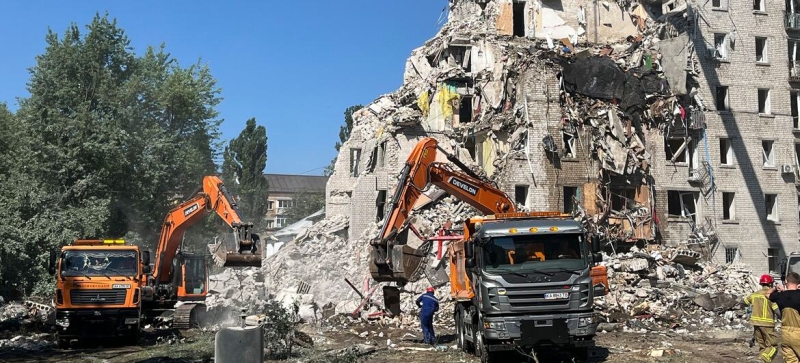

© UNICEF Kiev after a rocket attack. UNICEF: after massive attacks on Ukraine, the country’s children are losing a sense of security and hope for the future Peace and Security
After another large-scale air attack on Ukraine, employees of the Children’s Fund (UNICEF) are providing emergency assistance to affected families, but they warn that the consequences of war for children are not limited to physical injuries and destroyed homes. Night shelling, constant sirens and hours spent in shelters leave deep psychological traumas that can accompany a child throughout his life. The head of the UNICEF communications department in the country, Toby Fricker, spoke about this in an interview with the UN News Service.
UN News Service: Ukraine, and especially Kyiv, once again experienced one of the largest and most sustained air attacks. What is the situation in the capital and other regions of Ukraine after these attacks? The attacks continued for several hours. This morning we visited one of the most affected areas on the left bank of Kyiv.
Half of a residential building there was almost completely destroyed. A huge crater appeared next to another building, near a kindergarten. The kindergarten itself received serious damage – inside we saw badly damaged premises.
According to reports, at least 20 people have died, and this number, unfortunately, may increase. A 15-year-old girl is reported missing and rescuers continue to search for her and her family members. There are other children affected. This is a tragedy for all residents of the area.
When we were on the spot, what was most striking was not only the scale of the destruction, the most important thing was the feelings of the people who lost their homes. They tried to remove at least some surviving things from the apartments, if they could still go there. Many were in a state of shock.
A psychologist working through a UNICEF partner organization said people often say, “I don’t need help right now.” But this shock is a natural reaction to the shock experienced. Later, the realization of what happened comes, and then it is very important that there are specialists nearby who are ready to provide psychological support not only immediately after the tragedy, but also in the following weeks and months.
UN News Service: Many families spent that night in shelters. How such experiences affect children, their mental health and later life At the same time, not all families have shelters nearby. People have to look for a safe place at night or go down to the subway.
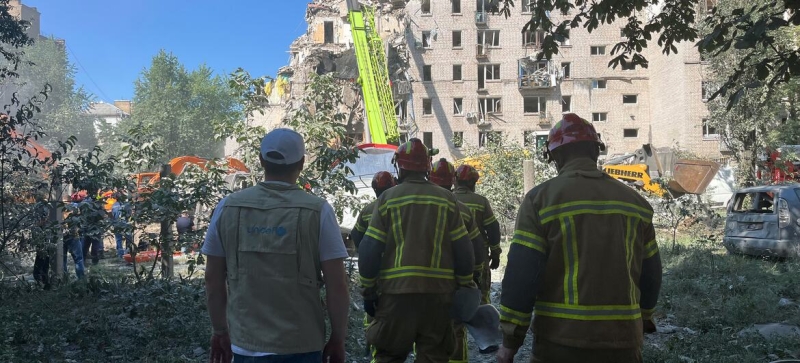
© UNICEF Rescuers work at the scene of a night attack in Kiev, Ukraine.
This should not become the norm. But for Ukrainian children and their parents, after more than four and a half years of war, this, unfortunately, has become part of everyday life.
The sound of night attacks is already terrifying in itself, let alone seeing the consequences or being attacked yourself. This affects children in different ways. Some people stop sleeping normally, some experience panic attacks, some find it difficult to communicate with friends and family.
These consequences can last a very long time. That is why it is so important to provide children and families with psychological support now in order to, if possible, prevent more serious consequences in the future. vulnerable?
TF: In our opinion, two groups are especially vulnerable.
The first is the smallest children in the first thousand days of their life. It is during this period that the foundations of human health and development are formed.
These children, like everyone else, experience what is happening, but cannot yet talk about their feelings and experiences. Therefore, the effects of stress can be difficult to notice immediately. But if families receive the necessary support from social workers and other specialists, even in such difficult conditions it is possible to help the child develop normally.
The second group is teenagers.
This is the age when young people begin to make plans for the future. But many teenagers have been living in war conditions for four and a half years. They were deprived of the opportunity to regularly meet with friends, study at school, and develop not only knowledge, but also life skills that are acquired in communication with peers.
All this has a particularly strong impact on teenagers. In addition, it becomes more difficult for them to make plans for a future profession, education and work.
UN News Service: What assistance UNICEF is providing now and what programs it is implementing in the long term perspective?
TF: Immediately after such attacks our first priority is to provide emergency assistance. We provide financial assistance to families who have lost their homes and property or whose homes have been damaged. This allows you to at least partially relieve financial difficulties. We also deliver essential items.
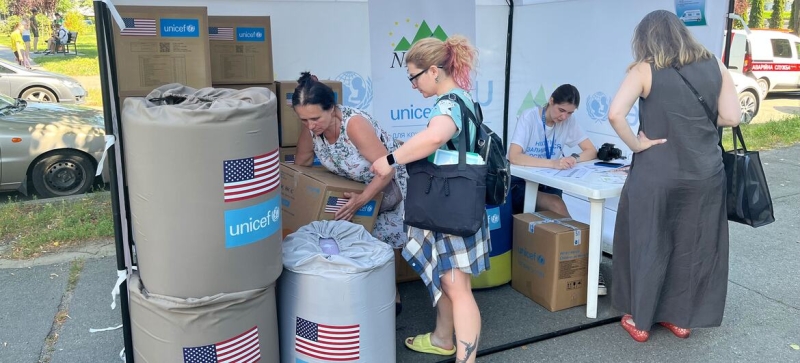
© UNICEF Humanitarian assistance after shelling of Ukraine.
Another important area is psychological support. Children should have the opportunity to talk to social workers, counselors and psychologists immediately after experiencing trauma.
If we talk about long-term work, our task is to provide children with conditions for full development. This means being able to attend school safely. We support the construction and arrangement of shelters, restore basements and turn them into safe spaces where classes can be held.
We also work with teachers, helping them support children who have survived difficult events, because teachers themselves also live in conditions of war.
In addition, we develop youth centers where teenagers can communicate, receive new skills and prepare for your future profession. Young people want to develop, they want to play an important role in the reconstruction of Ukraine, and we must help them prepare for this.
UN News Service: What stood out to you while communicating with children and families? What do you think is important for people outside to understand? Ukraine?
TF: Today we talked with our psychologist who worked with a teenager who suffered during the last attacks.
She said that after such a blow the child is completely loses a sense of stability and security. People are already accustomed to living under the threat of shelling, but when a blow hits you personally, it feels completely different.
That’s why it’s so important to talk to children, give them the opportunity to gradually talk about their feelings, do not rush them and accompany them for as long as necessary.
I remember another meeting – with a fifteen-year-old girl from the Sumy region. She had just returned to full-time learning after school reopened, but the school was soon damaged again and closed again.
She told me, “It feels like everything is gone again.” Life was just starting to get better, the girl was just starting to reconnect with friends, and she lost that opportunity again.
But there was a youth center nearby, where she was able to meet her peers again, try to learn new skills and feel that she still had a future.
This is what is especially important today. Young people don’t want to lose hope. They want to have their place in the world, develop and be successful.
UN News Service: And the last question. What message would UNICEF like to send to the world today? Always. And especially in times of war.
It is vital that UNICEF and our many local partners have the resources to continue their work.
This is not just about emergency assistance immediately after attacks or supporting families who have been forced to flee their homes. It is equally important to continue to accompany children in the future: help them return to school, tailor assistance to individual needs, provide reintegration programs and create conditions suitable for each child.