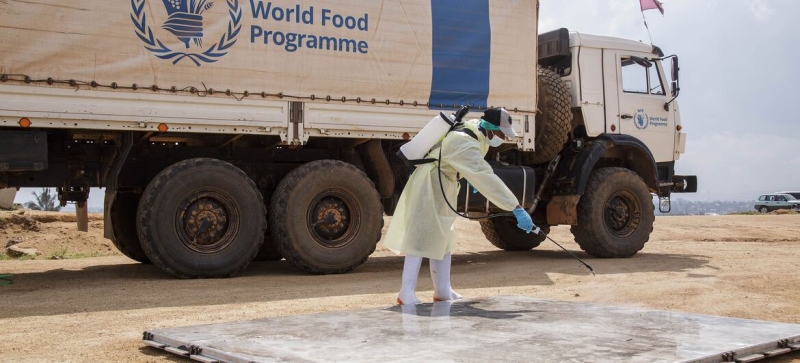

© VPP/Arete/S. Muyisa Disinfection at Bunia airport as part of the response to the Ebola outbreak in Ituri province, DR Congo. Ebola in DR Congo: record number of cases reported in first month of outbreak Health
The Ebola outbreak in eastern Democratic Republic of Congo (DRC) is spreading at an unprecedented rate and severely disrupting the daily lives of millions of people. Representatives of UN humanitarian agencies announced this on Tuesday.
World Health Organization (WHO) Emergency Response Director Abdirahmane Mahamoud, who recently returned from the DRC, said that as of Monday, the country had 1,048 confirmed cases of Ebola, of which 267 had been fatal. – he emphasized.
The current outbreak caused by the Bundibugyo virus and announced on May 15 is developing much faster than previous epidemics. According to Mahamoud, the 250 death mark was reached in just 37 days. This compares to 78 days during the 2014-2016 West African outbreak and 130 days during the 2018-2019 outbreak.
Daily life became dangerous
Deputy Director for Operations of the International Organization for Migration (IOM), Ugochi Daniels, noted that local residents were in an extremely difficult situation.
“Daily life has become fraught with risk. Grocery shopping or trying to earn a living can be dangerous,” she said.
Daniels said the outbreak has gone beyond just a medical problem.
“It is affecting every aspect of daily life, bringing uncertainty and fear,” the IOM spokeswoman said.
Monitoring on boundaries
A particular challenge is that foci of infection are located in areas of active cross-border population movement. Therefore, monitoring both formal and informal border crossing routes remains a critical challenge, especially in regions affected by conflict and instability.
IOM and partner organizations have already conducted more than a million health screenings of travelers at border crossings and major travel routes.
To coordinate cross-border responses and surveillance in The agency needs $55.8 million in 11 countries over the next six months, of which only about $20 million has been received. diagnostics
WHO notes that the scale of response to the rapidly spreading disease is also growing at a rapid pace. Over the past two weeks, the number of beds for treating patients has increased from several dozen to more than 500 beds in 19 medical zones.
Diagnostic capabilities have also been significantly expanded. Whereas at the beginning of the outbreak, laboratories in Kinshasa could conduct about 30 tests per day, now a network of eight laboratories in the provinces of Ituri, North Kivu and South Kivu provides more than 2 thousand tests daily. safe and dignified conditions.
The representative of the International Federation of Red Cross and Red Crescent Societies (IFRC), Paolo Cravero, said that the organization is delivering special materials to the affected areas for burials, despite the inaccessibility of many settlements and the difficult security situation.
However, He said one of the main problems remains a lack of trust among the population.
“As with any crisis or outbreak of a disease like Ebola, tensions are rising,” Cravero said.
He said IFRC volunteers have already encountered violence at venues burials.
“Rumors and misinformation create additional difficulties,” acknowledged the representative of the International Federation, stressing that the organization is actively working with local communities to overcome mistrust and strengthen cooperation in the fight against the spread of the disease.