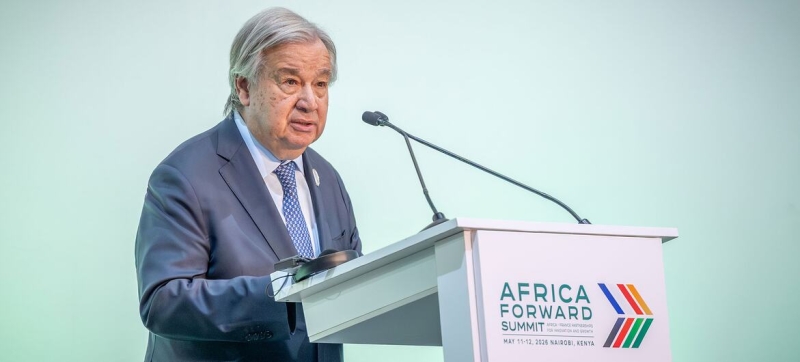

UN-Nairobi/J. Mwelu Secretary-General Antonio Guterres speaks at the Africa Forward Summit in Nairobi, Kenya. At the Africa Forward summit, the UN chief called for reform of the global financial system Economic Development
By 2040, Africa is capable of producing 10 times its own electricity from entirely renewable sources, yet 600 million people on the continent still live without electricity. This was stated by UN Secretary-General Antonio Guterres at the Africa Forward summit in Nairobi. The meeting is jointly organized by France and Kenya.
Guterres emphasized that today African countries are actively participating in one of the main discourses of our time – the reform of the global financial architecture, which was created in 1945 – “for a world that no longer exists.” According to him, it is African states that create tools such as the Borrowers’ Platform so that debtor countries can “negotiate from a position of strength.”
The continent is actively fighting against unfair credit rating systems and promoting the UN Framework Convention on International Tax Cooperation. whose economy they shape. At the same time, aid budgets are being cut and commitments are not being fulfilled.
“This is not only a funding crisis. This is a crisis of solidarity,” said the head of the UN.
The Secretary General paid special attention to climate justice. The African continent is suffering from the most serious consequences of global warming, although it is not one of the main causes of climate change. African countries have 60 percent of the planet’s solar potential, but receive only 2 percent of global clean energy investment. Because many families are unable to cook sustainably, 800,000 people die in Africa every year, mostly women and children.
And the cost of borrowing for African countries is twice that of OECD countries.
Guterres also called for an end to decades of resource exploitation: The “green transition” requires a huge amount of minerals that Africa is rich in, and the countries of the continent should benefit from their extraction.
“The people in Africa should benefit first and foremost from Africa’s resources,” said the Secretary General.
The continent’s partnership with the world, according to the head of the UN, should be built on equality. This means not just investment, but shared ownership of industries, support for African universities and the development of artificial intelligence based on African data and languages.