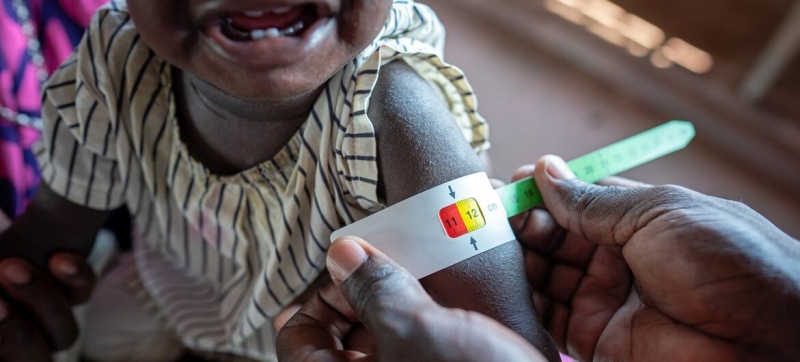

The health worker measures the child’s arm circumference to determine the level of malnutrition. Two thirds of the world’s hungry live in just 10 countries Peace and security
Hunger is concentrated in a small group of countries affected by war and instability, according to a new report prepared by UN agencies, the European Union and their partners. Two-thirds of people facing severe food insecurity live in just 10 countries.
According to the report, in 2025, 266 million people in 47 countries (almost a quarter of their population) experienced acute food insecurity. That’s nearly double the level in 2016.
The paper’s authors paint an alarming picture: hunger has ceased to be a series of short-term emergencies and has become an ongoing, localized global problem.
“Today, acute food shortages are not just widespread, but chronic, recurring. phenomenon,” warned the Director-General of the UN Food and Agriculture Organization (FAO), Qu Dongyu.
Conflict is the main cause of hunger
Military conflict remains a major cause of the crisis, accounting for more than half of all severe hunger.
Two thirds of people suffering from catastrophic food shortages live in 10 countries: Afghanistan, Bangladesh, Democratic Republic of Congo, Myanmar, Nigeria, Pakistan, South Sudan, Sudan, Syria and Yemen.
60~p>B In 2025, the situation reached a critical point in the Gaza Strip and parts of Sudan, where mass famine was officially confirmed. This is the first time in recorded history that two outbreaks of mass famine have been recorded within the same year.
“This report is a call to action,” UN Secretary-General Antonio Guterres said in the foreword to the report. “We must muster the political will to dramatically increase investment in aid and end the conflicts that cause so much suffering.”
The report also highlights that the situation has worsened sharply in recent years. More than 39 million people in 32 countries face extreme levels of food insecurity, and the number of people living in catastrophic hunger has increased ninefold since 2016.
Hunger poses a particular threat to children
Children have it the hardest. In 2025, 35.5 million children suffered from acute malnutrition, of whom almost 10 million experienced severe malnutrition. This condition directly threatens their lives and dramatically increases the risk of mortality.
“Children with severe malnutrition lose critical weight. Their immune systems are so weakened that even common childhood illnesses can become fatal,” warned UNICEF representative Ricardo Pires.
In the areas hardest hit by famine—Gaza, Myanmar, South Sudan, and Sudan—combat, epidemics, and limited access to health care are leading to unprecedented increases in wasting and death rates.
Forced population displacement is exacerbating situation
The scale of the crisis is increasing due to mass migration. Last year, there were more than 85 million displaced people in food crisis zones. Refugees and internally displaced people systematically experience acute hunger.
“Forced displacement and food insecurity are inextricably linked and form a vicious circle,” said UN High Commissioner for Refugees Barham Salih, stressing that humanitarian assistance alone is not enough to solve the problem.
Reduction financing
Despite the scale of the disaster, funding for relief programs is being cut. Funds allocated for food aid have fallen to the level of a decade ago, tying the hands of governments and humanitarian organizations.
At the same time, the so-called data gap is growing. The number of countries able to provide reliable food security reports has fallen to a 10-year low. This means that the actual scale of famine may be significantly higher than official estimates.
Gloomy Prognosis for 2026
The outlook for 2026 remains bleak. Due to protracted conflicts, extreme weather events and economic instability, the world is expected to experience critical food shortages.
Experts also point to new challenges associated with turmoil in global markets stemming from the Middle East. The crisis could lead to further food price increases and supply chain disruptions.
Humanitarian organizations warn that without a change of approach, the crisis will worsen.
“We must move from a model of delayed response to proactive action. We need to not just distribute food, but protect agricultural production at the local level. This way, the need for help can be reduced, people’s lives can be saved, and a stable system can be created for the future,” concluded Qu Dongyu.