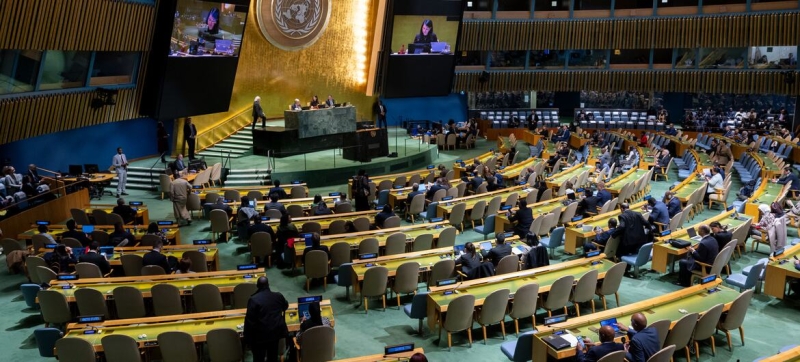

Meeting of the UN General Assembly dedicated to the International Day of Remembrance for the Victims of Slavery and the Transatlantic Slave Trade. The UN General Assembly adopted a resolution declaring the slave trade a grave crime against humanity Human rights
The world still lives in the shadow of a system that has dominated for 400 years – a system “born of greed, built on lies and maintained by violence.” With these words, UN Secretary-General Antonio Guterres spoke at a meeting in the UN General Assembly dedicated to the International Day of Remembrance for the Victims of Slavery and the Transatlantic Slave Trade.
At the initiative of Ghana, a resolution was put up for voting in the General Assembly recognizing the “trade in enslaved Africans” as a grave crime against humanity. The delegates accepted it by a majority vote. The document was supported by 123 countries, three states – the USA, Israel and Argentina – opposed, 52 – abstained.
Targeted dehumanization
The UN Secretary General emphasized that slavery was not just a historical crime, but the foundation of an unjust global economic system.
“It was not just forced labor. It was a system of massive exploitation and the deliberate dehumanization of men, women and children,” said the UN chief. According to Guterres, the fight against racism cannot be achieved without an honest recognition of how deeply ingrained these misconceptions are.“We must turn memories into progress and memory into responsibility. The world we seek – based on freedom, equality and justice – is within reach,” Guterres said.
He called on states to act boldly, recalling that a world based on equality and dignity will not happen on its own. “We have an obligation to honor victims not with words, but with our work,” the UN chief emphasized.
Eliminating injustice is a moral imperative
President of the General Assembly Annalena Burbock noted that slavery was one of the worst violations of human rights in history. Its consequences continue to shape the lives of the descendants of victims of the slave trade and entire countries, manifested in poverty and discrimination.
“Addressing these injustices is a moral imperative based on a collective responsibility to confront past crimes and shape a more just future,” Burbock said.
She emphasized that while systemic slavery remains past, its roots—discrimination, exploitation, and human rights violations—continue to manifest in new forms, including human trafficking and forced labor.
“We must therefore continually strive for justice while remaining active participants in the struggle for dignity, accountability and equality for all generations,” said Burbock.