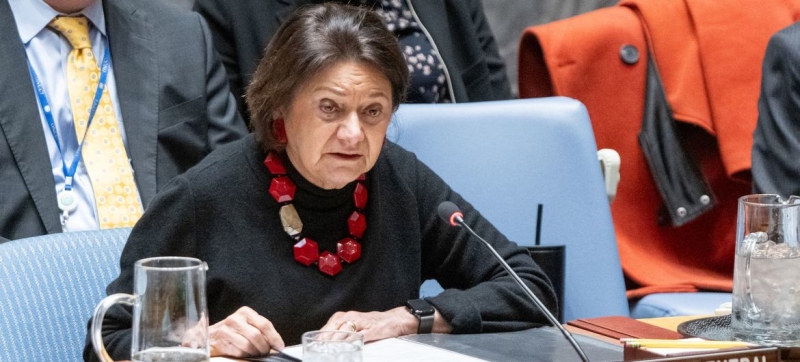

UN Under-Secretary-General for Political Affairs Rosemary DiCarlo in the Security Council. Photo from the archive The UN Security Council discussed the situation in the Middle East: “despite the truce, there is no peace in Gaza” Peace and Security
A senior United Nations official warned the Security Council on Wednesday that the Middle East is at a defining moment, with the fragile truce in the Gaza Strip offering a rare opportunity for progress but remaining seriously threatened by ongoing violence and a dire humanitarian situation.
Window of opportunity
Speaking at a meeting chaired by British Foreign Secretary Yvette Cooper, UN Under-Secretary-General for Political and Peacebuilding Affairs Rosemary DiCarlo said the coming weeks will determine whether the region can move towards stabilization or face a renewed escalation of conflict. After years of destruction and enormous human suffering, she noted, there is a “window of opportunity” for a change in the situation, “but it is neither guaranteed nor indefinite.”The UN calls on all parties and Security Council members to focus on consolidating the truce reached last October, as well as taking concrete steps towards reconstruction and progress towards lasting peace. A key element of these efforts remains the implementation of the next phase of the ceasefire agreement in Gaza and progress towards resuming the political process leading to a two-state solution. According to the speaker, these measures should include efforts to demilitarize the strip – the disarmament of Hamas and other Palestinian factions, as well as the transfer of powers to the National Management Committee Gaza.
Humanitarian access
DiCarlo said some progress has been made in expanding humanitarian access since the truce took effect, including the opening of the Rafah crossing to pedestrian traffic in both directions on February 2. This allowed medical evacuation of patients and ensured the return of hundreds of people. However, thousands of local residents still need treatment unavailable in Gaza.
Despite these advances, the humanitarian situation remains extremely difficult. The vast majority of the population of the Gaza Strip remains unable to return to their homes and lives in extremely difficult conditions. Relief operations face severe constraints, and severe shortages of shelter materials, medical equipment and educational supplies are hampering humanitarian efforts.
Airstrikes on Gaza
“Gaza is still not living in peace,” DiCarlo stressed, noting that in recent weeks Israeli airstrikes targeted densely populated areas, killing dozens of Palestinians, including women and children. At the same time, armed clashes continued between the Israeli military and Palestinian armed groups, highlighting the fragility of the truce.Meanwhile, the situation in the occupied West Bank is rapidly deteriorating. Israeli forces have stepped up operations, with raids, mass detentions and a growing number of displaced Palestinian families, especially in the north of the territory, according to the UN. Continued settlement expansion, demolitions and rising settler violence are further raising tensions.
DiCarlo warned that recent decisions by Israeli authorities could expand Israeli civilian powers over parts of the West Bank and accelerate settlement growth, raising serious concerns about possible forced population transfers and what she called the gradual “de facto annexation” of the territory. The UN stresses that Israeli settlements have no legal standing under international law.
The economic crisis is also adding pressure: withholding tax revenues is exacerbating the financial difficulties of the Palestinian Authority and leading to cuts in basic services.
Prospects for a durable peace
In conclusion, DiCarlo emphasized that at this “fragile stage” half-hearted measures are not enough. She called for full implementation of diplomatic initiatives, urgent local de-escalation, and a resumption of the political process that can lead to lasting peace and a viable two-state solution.