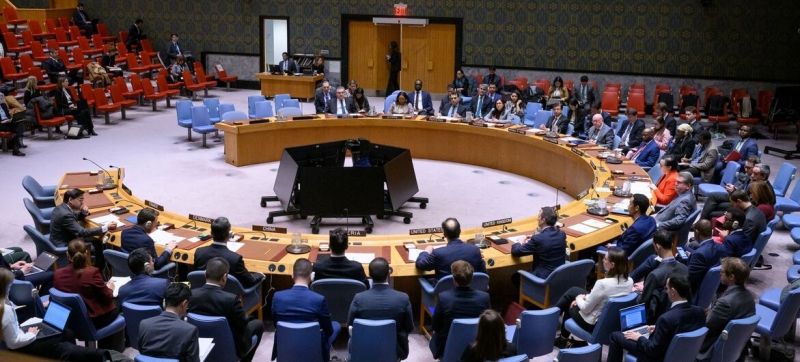

Meeting of the UN Security Council. UN Security Council: no agreements have been reached on the Iranian nuclear program in 2025 Peace and Security
Despite increased diplomatic efforts in the second half of 2025, no progress has been made on agreements regarding the Iranian nuclear program. This was stated by UN Under-Secretary-General for Political and Peacebuilding Affairs Rosemary DiCarlo during a Security Council meeting dedicated to implementation of resolution 2231 (2015).
Resolution 2231 was adopted in July 2015. It approved the Joint Comprehensive Plan of Action (JCPOA) on the Iranian nuclear program, which was adopted in 2015 as a result of lengthy negotiations with the participation of China, France, Germany, Russia, Great Britain, the United States, the EU and Iran itself. The deal provided for restrictions on Iran’s nuclear program in exchange for the lifting of previously imposed sanctions. The agreements provided for a “snapback mechanism” to return sanctions if the parties to the agreement believed that Iran was not fulfilling its obligations.
Failure to fulfill obligations
In August 2025, France, Germany and the United Kingdom notified the Security Council of their intention to activate this mechanism, citing Iran’s “substantial failure” to comply with its obligations.
Since the UN Security Council failed to adopt a resolution to extend the lifting of sanctions within the specified time frame, the previously in force measures were automatically restored after September 27 2025. However, a number of member states challenged the legality of this step. Russia, China and Iran also claimed that resolution 2231 ceased to apply on October 18, 2025. The Euro-three countries – France, Germany and Great Britain – rejected this position.
Referring to the latest report of the International Atomic Energy Agency (IAEA) dated November 12, 2025, DiCarlo recalled that Iran stopped fulfilling its obligations under the JCPOA on February 23, 2021. At the same time, the agency continued to review certain aspects of the program within the framework of the safeguards agreement under the Treaty on the Non-Proliferation of Nuclear Weapons (NPT). uranium in the country. The agency concluded that a “coordinated framework, with the support of interested countries is needed to ensure the exclusively peaceful nature of Iran’s nuclear program,” and noted the IAEA Director General’s readiness to engage with Iran “as soon as possible.”
60~h2>Diplomatic stalemate
A crisis in diplomatic efforts followed the escalation between Israel and Iran in June 2025 and US strikes on Iranian nuclear facilities.
Despite the deep differences between the parties, Rosemary DiCarlo stressed that all participants continue to say the importance of a diplomatic solution. According to her, “a negotiated settlement that will ensure the exclusively peaceful nature of the Iranian nuclear program and ease the pressure of sanctions remains the best option for the international community.” The UN Secretariat, she added, remains at the full disposal of the parties to facilitate this process.