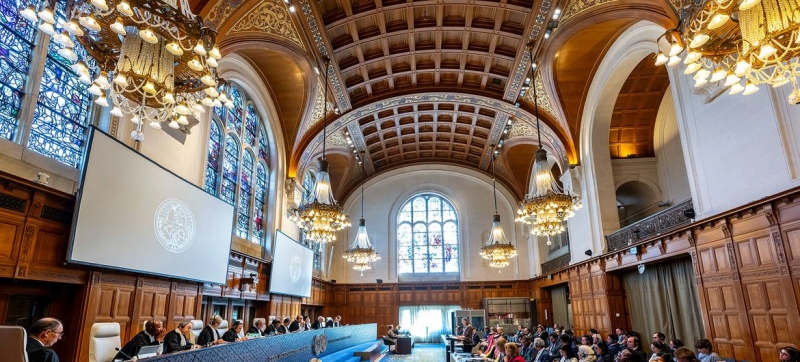

© International Court of Justice/F. van Beek The International Court of Justice found Russia’s counterclaim against Ukraine in the case of application of the Genocide Convention admissible International Law
The International Court of Justice found Russia’s counterclaim in the case concerning allegations of genocide (Ukraine v. Russian Federation) admissible. It will be included in the proceedings. The court also set deadlines for further submission of documents: Ukraine must submit its response by December 7, 2026, and Russia must submit its counterargument by December 7, 2027.
On the twenty-sixth of February 2022 – shortly after the start of the full-scale invasion of the Russian Federation – Ukraine filed an application with the Court to initiate proceedings against Russia over a “dispute … concerning the interpretation, application and implementation of the 1948 Convention on the Prevention and Punishment of the Crime of Genocide.”
According to a press release from the International Court of Justice, Ukraine claims that “the Russian Federation falsely declared that acts of genocide had been committed in the Luhansk and Donetsk regions of Ukraine and on this basis recognized the so-called “Donetsk People’s Republic” and “Luhansk People’s Republic”, and then declared and carried out a “special military operation” against Ukraine.”
Ukraine “categorically denies” the commission of such acts of genocide and states that it filed the application “to establish that Russia has no legal basis for taking measures with respect to and against Ukraine to prevent and punish the alleged genocide.”
In March 2022, the Court announced its decision on temporary measures related to the Ukrainian claim, and obliged Russia to immediately suspend military operations in this country.
In February 2024, the Court ruled on preliminary objections raised by Russia in October 2022: The Court has jurisdiction to hear Ukraine’s claim requiring the Court to find that there is no credible evidence that “Ukraine is responsible for the commission of genocide.” year. Ukraine challenged their admissibility, but the objections were rejected. “The Court finds that it has jurisdiction to hear the counterclaims of the Russian Federation pursuant to Article IX of the Convention on the Prevention and Punishment of the Crime of Genocide,” the Court said in a press release dated December 8, 2025.
The Court, located in The Hague, was created in 1945 to resolve disputes between states. It also issues advisory opinions on legal matters referred to it by other authorized organs of the UN.
The International Court of Justice is one of the six fundamental organs of the UN, along with the General Assembly, the Security Council, the Economic and Social Council (ECOSOC), the Trusteeship Council and the Secretariat. Unlike, for example, the Court of Justice of the European Union, the International Court of Justice is not the highest court to which national courts can appeal: it is authorized to consider a dispute only at the request of one or more states.