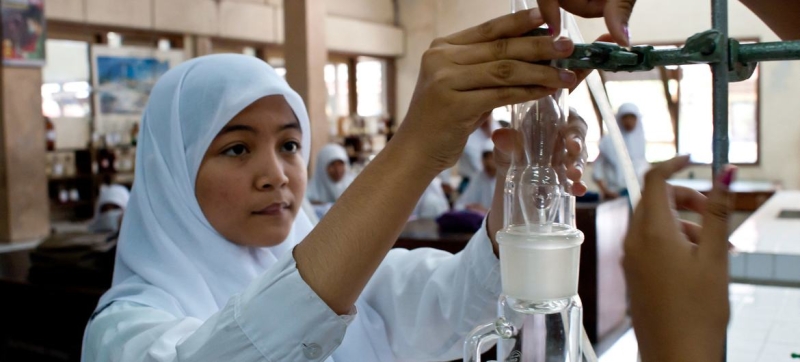

Students in a chemical laboratory in Indonesia. Millions of jobs at risk due to rapid adoption of AI Economic development
The rapid development of artificial intelligence (AI) could exacerbate inequality and destroy millions of jobs in developing economies. The United Nations Development Program (UNDP) warns about this in its new report.
According to the authors, AI opens up enormous opportunities for development, but at the same time developed and developing countries have unequal starting conditions. Without sound public policy, this could lead to a new round of global inequality and even undo decades of progress as the gap between poor and rich countries gradually narrows.
Asia –at the epicenter of the global transition to AI
Asia-Pacific, home to 55 percent of the world’s population, is emerging as a key player in the field of artificial intelligence. More than half of AI users are concentrated here, and the number of innovative companies is growing rapidly. In particular, China has almost 70 percent of world patents in this field.
Read also:
UN report: introduction of artificial intelligence will affect 40 percent of jobs
Using AI can increase the rate of annual growth of the region GDP by about 2 percentage points and improve productivity by 5 percent in sectors such as healthcare and finance. Southeast Asian countries alone could add nearly $1 trillion to to their total GDP in the next 10 years.
Serious Risks
Millions of Workers As AI Advances places may be at risk of extinction, and women and youth will be in a particularly dire situation. which traditionally women are involved, is almost twice as high as in other types of labor activity. Young people aged 22-25 are already facing challenges in finding work, especially in sectors where AI is being used the most.At the same time, in a number of countries, AI is helping authorities work more efficiently and achieve significant results to improve the standard of living of the population. For example, Singapore has reduced the time required to complete documents for young parents from two hours to 15 minutes. In Beijing, “digital copies” are used for urban planning and combating floods.
However, only a few states have full-fledged laws regarding artificial intelligence. It is estimated that by 2027, more than 40 percent of AI-related violations will be related to the misuse of generative technologies. Governments should take these trends into account when developing laws.
Rising inequality
There is a significant gap between countries, with Singapore, South Korea and China investing heavily in AI technologies and related training, while others States of the region still must provide the population basic access to the Internet. Limited infrastructure, lack of skills, computing power and management potential constrain the use of artificial intelligence and at the same time strengthen risks.
According to Chief UNDP Economist Philip Schellekens, countries that invest in training, technology and regulation will reap significant benefits. The rest risk being left far behind.